Hair Loss Specialist in NYC: Get the Labs Before the Treatment
Before you buy a serum or book a procedure, learn why your hair is thinning. A physician explains the labs, hormones, and hair loss types that guide treatment.

Most women who come in about thinning hair describe it the same way: the drain, the brush, the pillow. There is more hair in them than there used to be, or the ponytail feels thinner, or the part looks wider under bathroom light. The first question is almost always the same too. What is causing this, and what do I do about it?
The most useful thing to know at the start is that hair keeps a calendar. What you see falling today was set in motion weeks or months ago, and what you will see next season is being set in motion now. Once that is clear, an apparently mysterious symptom becomes a timeline that can be worked backward, and the list of possible causes, from a winter fever to the long arc of menopause, shrinks to the ones that fit the dates.
This article walks through that timeline. It explains how to tell shedding from thinning, which triggers show up three months late, which causes build over half a year and which reflect hormonal drift over years. It describes how a careful physician sorts perimenopause, iron, thyroid and androgens, and where treatment fits. It is for women in New York who want to understand their hair before they spend money on it.
Hair grows in cycles. Each follicle spends a long period in a growth phase that lasts years, then a brief transition, then a resting phase of about three months, after which the resting hair is shed and a new one begins to grow in its place. At any given moment, most of the hair on your head is growing, and a small fraction is resting.
Normal shedding is a part of that cycle. A person typically loses somewhere around a hundred hairs a day, which is why a few strands in the shower are not alarming. What changes in a problem is the proportion. When some event pushes a large number of growing hairs into the resting phase at the same time, they all shed together about three months later. That delay is the key to the detective work.
So when a woman says her hair began falling out heavily last month, the useful reply is to ask what happened around three months before. A fever, an operation, a childbirth, a stretch of severe stress, a sharp weight loss, a new medication. The shedding is the echo, and the cause is in the past. If nothing stands out, the next question is whether the cause is slower and still active. Working from a timeline in this way is how a physician like Dr. Bissoon approaches the first visit, because the dates often point to the diagnosis before any test does.
Words matter here, because three different patterns get lumped together. Shedding means more hairs falling, often diffusely across the scalp, with the overall volume dropping but the pattern looking even. Thinning means individual hairs are getting finer and the part is widening, often in a particular area. Patchy loss means defined areas have lost hair entirely, with skin visible and sharp edges.
Diffuse shedding, called telogen effluvium in the literature, is common, usually temporary and often follows an identifiable trigger. Gradual thinning at the crown or along the part, with the front hairline preserved, is typical of female pattern hair loss, which is common, progressive and tied to hormones and genetics. Patchy loss suggests other processes, including autoimmune alopecia areata, and calls for a different evaluation.
Many women have a mix. A woman with early pattern thinning can experience a shedding episode after illness that makes everything suddenly look worse, which is why a single moment of alarm is poor evidence for a single cause. Photographs and a timeline separate the layers better than memory does.
The first group of causes follows the delay rule. A significant event pushes hairs into rest, and the shedding arrives about a quarter of a year later.
Illness is the commonest trigger, particularly high fever, influenza, COVID-19 and other infections. Surgery and general anesthesia can do it, as can a major injury. Childbirth is a classic cause, since the hormonal environment of pregnancy keeps more hairs in growth, and after delivery a large cohort shifts to rest at once. Rapid weight loss, whether from illness, a restrictive diet or deliberate effort, is another. So are periods of intense emotional stress, bereavement, divorce or relocation.
Medication changes belong on this list too. Starting or stopping hormonal contraception, thyroid medication, antidepressants, anticoagulants, retinoids and several others can precipitate shedding in susceptible people. Stopping a contraceptive pill, for example, can produce a shed a few months later as the hormonal milieu changes.
The reassuring feature of these triggers is that they are usually self limiting. Once the trigger has passed, the follicles resume growth, and shedding typically settles over several months, with regrowth following. The unreassuring feature is that people often do not make the connection, and the delay makes it seem as if nothing has changed. Telling a woman that her shedding likely reflects a bout of illness in the winter is often the most helpful thing a physician can do.
Rapid weight loss is among the most common reasons women arrive with shedding, and it deserves more attention than it gets. When calories drop sharply, the body triages, and hair is not a priority. Low protein intake in particular starves the follicle of building material, and diets that eliminate whole food groups can leave gaps in iron, zinc and essential fatty acids. The shed then arrives a few months after the diet began, often just as the person has reached their goal weight, and the timing feels cruel.
The practical lesson is that the pace and composition of weight loss matter for hair, and that adequate protein, iron where needed and steady rather than extreme restriction protect it. Digestion is part of the story too, since nutrients that are eaten but not absorbed do not reach the follicle, and the link between gut health and whole body wellbeing is a reasonable thing to raise at an evaluation, particularly when thinning comes with bloating or irregular digestion.
A second group of causes does not arrive as an event. It builds quietly, and the shedding continues for as long as the condition does.
Iron deficiency is the best known. Hair follicles are metabolically active, and low iron stores, measured by ferritin, are associated with shedding in many women, especially those with heavy periods, vegetarian diets or a history of pregnancies close together. Thresholds for what counts as low enough to matter for hair are debated, and many clinicians look at ferritin more carefully than a standard anemia screen does, since a woman can have stores that are low for hair purposes while her hemoglobin is normal.
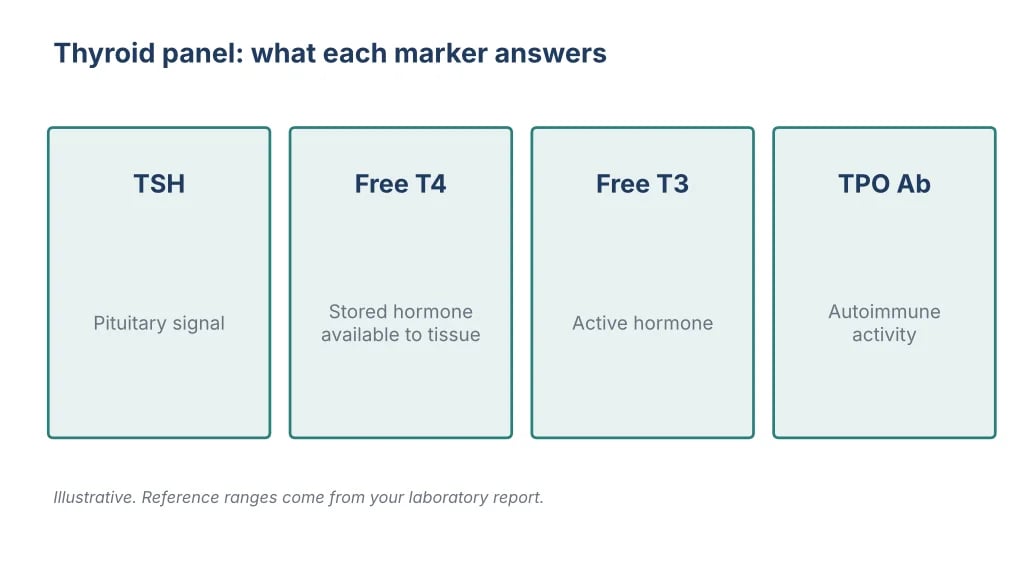
Thyroid disease is another. Both underactive and overactive thyroid glands can cause diffuse thinning, along with changes in energy, weight, mood and cycles. It is common in women, particularly after pregnancy and in midlife, and it is easy to test for. Vitamin D, vitamin B12, zinc and protein intake also feature in the evaluation, though their individual contributions are often smaller and the evidence less clear than for iron and thyroid.
Digestive health matters in this group because absorption determines whether nutrients reach the follicle at all. Conditions that impair absorption, from celiac disease to chronic inflammation of the gut, can produce deficiencies that show up in the hair first. The wider relationship between digestion and how the body feels is a reasonable thing to raise when thinning accompanies bloating, irregular digestion or food sensitivities.
During pregnancy, higher estrogen keeps more hairs in the growth phase, so many women notice thicker hair. After delivery, estrogen drops, and a large group of those hairs shifts to rest together. Around three to four months later, handfuls come out in the shower and around the hairline, and the temporary alarm can feel out of proportion to the cause.
For most women this resolves on its own over several months, and the regrowth shows up as short new hairs along the temples and forehead. When it does not, or when it comes with fatigue, cold intolerance, weight changes or a low mood, thyroid problems after pregnancy are common enough to check. Iron stores often drop through pregnancy and delivery as well, which makes a ferritin check sensible whatever the cause turns out to be.
The third group is the one that most often brings women in their forties and fifties to a hormone focused practice. Over years, hormone levels change, and hair responds.
Perimenopause, the stretch of years before menopause proper, can begin in the early to mid forties and last several years. Estrogen and progesterone fluctuate, often erratically, and then decline. Estrogen supports the growth phase and hair thickness, and as it falls, the balance with androgens, which are present in every woman, can shift. Hair can become finer, drier and slower to grow, and the part can widen. Many women notice that other hair changes at the same time: eyebrows thin, and hair in the underarms and pubic area becomes sparser. Where exactly the hair goes is itself informative, and the map of hormonal shedding across the body is worth knowing.
The point of the calendar here is that hormonal drift does not have an onset date. A woman who says her hair began thinning last year may be seeing a slow trend that started much earlier and finally crossed the threshold of visibility. Looking at old photographs, particularly hairline and part photos from several years ago, is often more informative than recall.
Other signals tend to accompany hormonal drift: irregular cycles, hot flashes, night sweats, poor sleep, mood changes, vaginal dryness and brain fog. When thinning arrives with these, the hair is one symptom of a larger transition, and treating it in isolation is less likely to work than addressing the whole picture.
Androgens, the hormones usually associated with men, are normal in women and play roles in libido, muscle and bone. They also influence hair follicles. In some women, scalp follicles are genetically sensitive to androgens and respond by shrinking over time, producing the pattern of widening part and thinning crown that characterizes female pattern hair loss.
This does not require high androgen levels. Many women with female pattern loss have normal blood levels, and the sensitivity is in the follicle. In others, androgen excess is part of the picture, as in polycystic ovary syndrome, where irregular cycles, acne and increased facial or body hair accompany scalp thinning. Distinguishing the two matters, because the evaluation and treatment differ.
Menopause adds a twist. As estrogen declines, the relative weight of androgens increases even if their absolute levels fall, which is one reason pattern thinning often accelerates in the late forties and fifties. This is also a reason that interpreting hormone tests requires context: a number that is normal for a laboratory's reference range may still be a change for that woman.
Scalp hair gets the attention, but the same hormones act on hair elsewhere. The outer third of the eyebrows thins in many women through their forties and fifties. Underarm and pubic hair become sparse, sometimes to the point that women think something is wrong. Eyelashes shorten. Facial hair, on the other hand, may become coarser, because the balance between estrogen and androgens has shifted.
These changes are common in the menopausal transition and are rarely dangerous, though they can be distressing. They also help with interpretation. Thinning that appears together with sparse brows and body hair, dry skin and changes in cycles points toward a hormonal explanation, while thinning in isolation after a fever points elsewhere. A fuller account of the overlap between aging and hormones can be found in the discussion of hormonal aging, which describes the signs that tend to travel together.
Hormones given as medication can help or hurt, depending on the type and the person. Some hormonal contraceptives contain progestins with androgenic activity that can worsen pattern thinning in susceptible women, while others have anti-androgenic properties. Starting, stopping or switching can all precipitate shedding.
Menopausal hormone therapy raises its own questions. For many women, restoring estrogen improves hair quality and density, as part of a broader improvement in symptoms. The response is not uniform. The choice of estrogen, the type of progesterone or progestin, the route of administration and whether testosterone is included can influence the outcome, and a woman whose hair worsened on one regimen might do better on another. The case for hormone therapy in midlife extends well beyond hair, and the reasons women consider bioidentical hormones are broader than any one symptom.
The honest summary is that hormone therapy is not a hair loss treatment in the way minoxidil is, but that hair often improves as a side effect of correcting a deficiency, and that it should be individualized and monitored. Women who begin treatment for hot flashes and sleep and find their hair thickening are common, though not universal.
Severe stress is a recognized cause of shedding, and it works through the same resting phase mechanism as illness. A bereavement, a job loss, a move or a period of caregiving can push hairs into rest, and the shedding follows about three months later. Chronic lower grade stress is harder to pin down, but poor sleep and constant stress hormone activation affect nearly everything else that influences hair, including appetite, iron absorption, thyroid function and cycle regularity.
This is not a reason to dismiss a woman's hair loss as stress. It is a reason to examine stress as one of several contributors, and to avoid the opposite error of assuming that because stress is present it must be the cause. Many women find that identifying a real trigger, and seeing the hair recover after it passes, is more reassuring than any reassurance offered in advance.
Most thinning is not urgent, but some patterns need prompt evaluation because they can cause permanent loss. A scalp that is red, scaly, painful, itchy or tender, with visible inflammation around follicles, should be seen. So should smooth, shiny patches where follicle openings have disappeared, which suggests scarring. Rapid patchy loss, loss of eyebrows or eyelashes along with the scalp, or hair loss accompanied by joint pain, rashes or fatigue also deserve a quick look.
These patterns may indicate scarring alopecias or autoimmune conditions that respond best to early treatment. Waiting several months to see whether it improves is reasonable for diffuse shedding after a clear trigger and unwise for these. A physician can examine the scalp directly, and a dermatologist referral or biopsy may be needed.
Laboratory testing for hair loss works best when it is targeted. A broad panel with no hypothesis wastes money and produces incidental findings. A targeted review starts from the history and timeline.
Commonly it includes a complete blood count and ferritin, thyroid stimulating hormone with, where indicated, free thyroid hormones and antibodies, vitamin D and B12, and a metabolic panel with glucose. For women with cycle irregularity, acne or body hair changes, androgen markers and other reproductive hormones are added. For women in the menopausal transition, estradiol, progesterone, follicle stimulating hormone and testosterone are considered, and when replacement is on the table the effects reach well beyond hair, as the discussion of BHRT and mood shows, with the understanding that perimenopausal levels can swing from week to week, so a single result must be read with care.
Timing matters. Reproductive hormones vary through the menstrual cycle, so testing is often scheduled on a particular day for women who still cycle. Iron studies can be affected by recent inflammation. Interpretation depends on the whole picture, which is where a physician's judgment adds more than the report itself. A physician led, diagnostics first approach fits this kind of problem well, since the answer usually sits in the pattern of results and not in any one number.
Many women arrive having already started a hair supplement, and biotin is the most common ingredient. Biotin deficiency is rare, and there is little evidence that supplementing it improves hair in people who are not deficient. More important for anyone having blood tests, high dose biotin can interfere with certain laboratory assays, including some thyroid and hormone tests, and cause falsely high or low results.
The practical advice is to tell your physician about every supplement, and to ask whether to pause biotin for a period before blood work. The same applies to other products marketed for hair, which often combine several vitamins and minerals in amounts that may or may not be appropriate. More is not better, and some ingredients, such as high doses of vitamin A or selenium, can themselves cause hair loss.
A balanced diet with adequate protein, iron where needed and enough calories supports hair more reliably than a capsule. Crash diets, in particular, are a common cause of shedding, which is a reason that how a person loses weight matters as much as whether they do.
Treatment follows diagnosis. If shedding is driven by a correctable factor, such as iron deficiency or thyroid disease, correcting it is the primary treatment, and hair usually recovers over months, because follicles need time to cycle back. If a trigger has passed, reassurance and patience are the treatment.
For female pattern hair loss, topical minoxidil is the most established, widely used option, and it works by prolonging the growth phase and increasing follicle size. It requires consistency, and results take months to appear. Some women are prescribed oral medications off label, including low dose oral minoxidil and anti androgen drugs such as spironolactone, each of which has benefits and risks and needs physician supervision. Low level laser devices have some supporting evidence. Procedures such as hair transplantation address stable, localized loss. For women whose loss is diffuse, transplantation is often a poor fit, since the donor hair may itself be thinning, which is why a careful evaluation matters before anyone is referred for a procedure.
Regenerative approaches, which in some practices include platelet rich plasma injected into the scalp, have attracted interest, with small studies suggesting benefit in some patients and an evidence base that is still maturing. Anyone considering them should ask for an honest account of how strong the data are and what results to expect, including how many sessions are typical, what a realistic improvement looks like and what happens if nothing changes. A clinic that answers those directly is showing the kind of candor the rest of the plan will need. Regenerative medicine has a role as part of a plan, and it is not a substitute for finding the cause.
Sorting hair loss well takes time that a short appointment rarely provides. The history alone, covering the timeline of events, the medications, the cycles, the family pattern and the diet, can take most of an hour. Laboratory results then need to be interpreted in context, and the first plan almost always needs adjusting after the first few months. Progress is measured in photographs and follow up, not in a single decision.
That kind of continuity is what the concierge model is built around: time to listen, access between visits, and a physician who remembers the part of your hair from last spring. For a problem that unfolds over a year, that matters more than it might seem.
Because hair is slow, expectations need to be slow too. After a trigger resolves or a treatment begins, it typically takes months to see a difference, and often most of a year to judge it. Shedding may even increase briefly when some treatments begin, as follicles synchronize. Patients who expect results in a few weeks tend to give up just before they would have seen them.
The best tool for tracking is a photograph. Take pictures of the part, the crown and the hairline in the same light, at the same distance, once a month. Keep a note of events: illnesses, medication changes, stressful periods, cycle changes. Over six months, the pictures and the notes tell a story that memory cannot, and they help the physician judge whether a plan is working.
Hair also reflects overall wellbeing. Sleep, stress, nutrition and exercise all influence the follicle, and the everyday habits that support healthy aging are as relevant to hair as to anything else, and taking proactive steps early is easier than catching up later.
It is worth stepping back to notice what thinning hair can mean. Often it is simply a hair problem. Sometimes it is the first visible sign of something the body has been signaling more quietly: an iron deficit, a sluggish thyroid, a shifting hormonal balance. Paying attention to it is a chance to learn something earlier than you otherwise would.
That is the spirit of curiosity about aging, so that a change in the mirror becomes information instead of worry. The goal is neither to panic at each hair on the pillow nor to ignore a pattern that merits a look, but to be curious, measure what can be measured and act on what is found.
If your hair has been thinning for more than a few months, or you notice it together with other changes, an evaluation is worthwhile, and the office on West 74th Street can schedule one. The first conversation will focus on the timeline: what changed, when, and what else came with it.
Bring photographs from earlier years, a list of medications and supplements with start dates, the dates of any recent illnesses, surgeries or pregnancies, and whatever laboratory results you have. From there the work-up and the plan follow. Many women find that having a clear explanation, whatever it is, is a relief in itself, and that hair which looked like an unsolvable mystery turns out to have a dated, understandable cause. Even when the answer is simply patience, knowing why makes the waiting easier to bear.
Sudden shedding usually reflects a trigger from about three months earlier, such as illness, surgery, childbirth, rapid weight loss or major stress, because hairs shift into a resting phase together and shed later. Gradual thinning has other causes.
Yes. Changing estrogen and progesterone and a shift in the balance with androgens can make hair finer, slower growing and thinner at the part. It often comes with cycle changes, hot flashes, poor sleep or thinning in other body areas.
Commonly a complete blood count, ferritin, thyroid tests, vitamin D and B12, and a metabolic panel, with androgen and reproductive hormone tests added when the history suggests them. The history guides the selection.
It can. Low iron stores, measured by ferritin, are associated with shedding in many women, especially with heavy periods or restrictive diets. Hemoglobin can be normal while ferritin is low, so ask about ferritin specifically.
Both underactive and overactive thyroid conditions can cause diffuse thinning. They are common in women and easy to test, so thyroid function is part of nearly every evaluation.
No. Telogen effluvium is diffuse shedding after a trigger and is usually temporary. Female pattern hair loss is a gradual, progressive thinning, often at the part and crown, linked to genetics and hormones.
Hair often improves when a hormone deficiency is corrected, but hormone therapy is not a dedicated hair treatment, and responses vary with the type of hormones and the route used. It should be individualized and monitored.
There is little evidence it helps people who are not deficient, and high doses can interfere with some blood tests. Tell your physician about it and ask whether to pause before testing.
Because follicles move through cycles, improvement after a trigger resolves or treatment starts usually takes several months, and judging a result can take most of a year.
A painful, red or scaly scalp, smooth shiny patches, rapid patchy loss, or hair loss with joint pain, rashes or fatigue should be examined promptly because some conditions can scar the scalp.
Starting, stopping or switching hormonal contraception can trigger shedding, and some progestins can worsen pattern thinning in susceptible women. Tell your physician which method you use.
It depends on the pattern. Scalp disease and scarring call for a dermatologist, while thinning with hormonal or metabolic clues benefits from a physician who evaluates the whole picture. Many women need both.
This page was written and medically reviewed by Lionel Bissoon, D.O., founder of Liondale Medical. Dr. Bissoon is a board-certified osteopathic physician specializing in anti-aging and concierge medicine on the Upper West Side of Manhattan.
This content is for educational purposes only and does not constitute medical advice. Individual results may vary. Consult a qualified physician before beginning any new treatment.
Published