Finding Therapeutic Plasma Exchange Near You in NYC
Finding therapeutic plasma exchange (TPE) near you in NYC: how to evaluate providers, what to expect, safety, and why location matters. Liondale Medical.

The nickname spread because it is easy to picture. An engine runs, oil gets dirty, the dirty oil is drained and clean oil goes in. A mechanic would not call that a miracle. It is routine maintenance. Applied to blood, the phrase "blood oil change" suggests something equally simple and equally reassuring: take out the old, put in the new, and carry on.
Therapeutic plasma exchange does have a family resemblance to that picture, which is why the nickname sticks to it. Part of the blood is removed. A replacement fluid goes in. The whole thing happens through a machine. But the comparison breaks down in ways that matter, and people who walk into a consultation with an oil change in mind often leave with a more complicated, and more accurate, understanding. The phrase is also used loosely in this field, and this article applies it only to plasma exchange. Other blood treatments that borrow the nickname work by different mechanisms, and nothing here describes them.
This article takes the analogy seriously and tests it. It explains what plasma is, how the procedure works step by step, what the machine does, what replaces the plasma, what is and is not removed, why one session does not clean the blood and what the comparison leaves out. It is written from the viewpoint of a physician-led clinic, Liondale Medical, where Dr. Lionel Bissoon treats plasma exchange as a medical procedure with specific mechanics, risks and limits. Nothing here promises a particular benefit, and the article does not describe what the procedure treats, which is covered elsewhere.
Blood has two main parts. About 45 percent by volume is cells: red cells that carry oxygen, white cells that fight infection and platelets that help clotting. The remaining 55 percent or so is plasma, a pale yellow liquid that carries everything else.
Plasma is mostly water, but it holds a long list of dissolved substances. Proteins such as albumin, which keeps fluid in the vessels and carries many hormones and drugs. Antibodies, which defend against infection. Clotting factors, which allow bleeding to stop. Fats and cholesterol packaged in particles. Hormones, vitamins, minerals, waste products and signaling molecules.
In plasma exchange, the cells are kept and returned to the body. The plasma is removed and replaced. This is the first place the oil change analogy begins to strain, because oil is a single substance and plasma is a complex mixture, most of which is needed. Removing it removes helpful components along with unwanted ones.
For this reason, plasma exchange is better thought of as replacing a complicated fluid with a simpler one than as cleaning a fluid. What was in the plasma leaves, and what goes in is a standard solution that does not contain the full range of what was there.
The procedure is performed with an apheresis machine, a device built to separate blood into parts. The process is the same in principle across models, and it is worth seeing as a sequence.
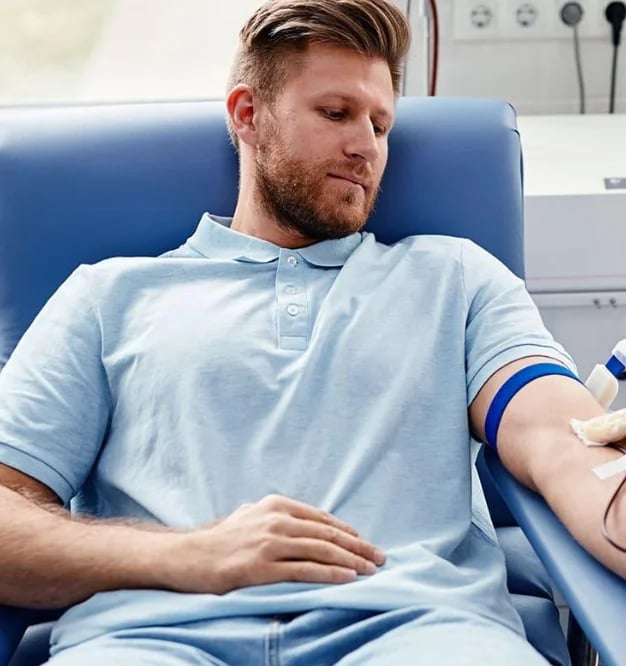
Access comes first. Blood leaves the body through a needle or catheter, usually in the arm, and travels through sterile tubing to the machine. A second line returns blood to the body, either through a second needle or the same access, depending on the machine and the patient's veins.
Anticoagulation follows. As blood enters the machine, it is mixed with an anticoagulant, commonly a citrate solution, so it does not clot in the tubing. Citrate works by binding calcium, which the clotting process needs, and this has consequences for the patient that are discussed below.
Separation is the heart of the process. The machine spins the blood in a centrifuge or passes it through a filter, depending on the design. Centrifugation separates components by density, so that cells settle to one layer and plasma to another. Membrane systems use a filter with pores that allow plasma through but hold cells back. In either design, the plasma is diverted to a collection bag while the cells continue.
Replacement is the next step. The cells are returned to the patient along with a replacement fluid in volumes matched to what has been removed, so that the amount of fluid in the circulation stays stable.
Monitoring runs throughout. Pressure sensors, air detectors and volume controls watch the circuit, and a nurse watches the patient, checking blood pressure, pulse and symptoms.
A session typically runs for a couple of hours, depending on the size of the patient, the volume exchanged and the machine.
The replacement fluid is a crucial detail that the oil analogy hides, and it is worth understanding.
Albumin solution is the most common replacement in many settings. It is a purified human protein in a saline base, which restores the oncotic pressure that holds fluid in the vessels and supplies a major carrier protein. Because it is processed, it carries a very low risk of transmitting infection.
Donor plasma, usually called fresh frozen plasma, is used in specific situations, particularly where the missing substance is something it contains, such as certain clotting factors or enzymes. It comes from donors and carries the risks of any blood product, including allergic reactions and, rarely, lung injury.
Saline or other crystalloid solutions may be used for part of the replacement in some protocols, usually combined with albumin, because they are inexpensive and safe but do not hold fluid in the vessels the way proteins do.
The choice depends on the reason for the exchange, the patient's condition and the setting. A clinic should be able to say what it uses and why. Importantly, none of these fluids replicates the patient's own plasma. They return volume and pressure and carry some protein, but they do not restore the particular mix of antibodies, clotting factors, hormones and other molecules that were removed.
Another place the analogy misleads is in the idea of completeness. A mechanic can drain nearly all the oil. Plasma exchange cannot.
When one plasma volume is exchanged, meaning an amount equal to the patient's total plasma, the concentration of a large substance that stays in the bloodstream falls by roughly 60 to 65 percent, not 100 percent. The reason is that the new fluid mixes with the remaining plasma continuously during the procedure, so some of what is removed is diluted material and not the original. Exchanging more volume removes more, but with diminishing returns, and it requires more time, more fluid and greater exposure to the risks of the procedure.
Distribution adds another complication. Many substances do not stay only in the bloodstream. Some antibodies, for instance, are spread between the blood and the tissues, and only a portion is in the plasma at any moment. After the exchange, substances in the tissues move back into the blood, a phenomenon called rebound. As a result, levels tend to climb partway back in the hours to days following a session.
Consequently, a single exchange does not clean the blood. It lowers the concentration of certain large molecules temporarily, and the extent and duration depend on how much of the substance is in the plasma, how fast the body makes more and how it redistributes.
Small molecules and substances inside cells are largely beyond what plasma exchange touches.
Plasma exchange removes things that are in the plasma, with a preference for larger molecules, since the plasma is replaced as a whole. Substances that live mostly in tissues, such as fat-soluble compounds stored in fat, are not removed in meaningful amounts, because only a small fraction of them circulates in the plasma at any given time.
Things inside cells, including red cells, white cells and the cells of organs, are not removed. The cells are returned to the patient, and the tissue is untouched.
Small, water-soluble molecules that are freely distributed throughout body water are removed only in proportion to the small share of body water that is plasma, and the body restores balance quickly. Kidney and liver function continue to do the work of clearance they always do.
This is why claims that plasma exchange removes all toxins, flushes out chemicals or resets the body need careful scrutiny. The procedure has a specific mechanical reach, and it is limited to the plasma and its large dissolved components. The scientific discussion of one such claim appears in the evaluation of microplastics, where the question is whether and how much of such particles can be reached in the first place.
Because plasma contains useful things, removing it has costs, and an honest description of the procedure includes them.
Antibodies are removed along with the plasma, including those that protect against infection. After an exchange, levels of protective immunoglobulins can fall substantially and recover over days to weeks. People who are exchanged repeatedly may need monitoring of immune function, and some may be given replacement antibodies in specific situations.
Clotting factors are also diluted. Levels recover within a day or two, but immediately after an exchange, clotting tests may be abnormal. This is one reason people on blood thinners or with bleeding disorders need specific planning.
Albumin is replaced when used as the replacement fluid, but other proteins are not, and so some carried molecules, including certain hormones and medications bound to plasma proteins, are removed and diluted. This is relevant for anyone taking drugs that are heavily protein bound, whose levels may shift. A clinician should review medications beforehand.
Calcium is affected not by removal but by the citrate anticoagulant, which binds calcium in the blood. Symptoms such as tingling around the mouth and fingers, a metallic taste, chills or cramping are common and signal low ionized calcium. They are managed by slowing the process or giving calcium, and they resolve quickly.
Electrolytes, blood pressure and fluid balance shift during the procedure, which is why monitoring is standard.
The mechanics explain the safety measures that a good program uses.
Screening comes first. A review of medical history, medications, allergies, kidney function, blood counts, calcium and clotting is standard, as is a check of vein access. Deciding who is a reasonable candidacy match, and who should not be treated, is part of that screening.
During the session, a trained nurse and a supervising physician should be available. Vital signs should be checked regularly, and the team should be prepared to manage calcium symptoms, low blood pressure, allergic reactions and access problems.
Afterward, observation and instructions about hydration, activity and warning signs are given. Follow-up labs may be drawn to see what changed.
A procedure involving a machine, a large volume of blood outside the body and a replacement product deserves this level of care. A setting that treats it casually, or without physician involvement, should raise questions.
A first-time visitor often watches the device more than the clock, and the machine is easier to follow once its parts have names.
The tubing set is a single-use kit. It includes the lines that carry blood out and back, the chamber where separation occurs, the bags for waste plasma and replacement fluid and a line for the anticoagulant. Everything that touches blood is sterile and is discarded afterward, which removes any question of one patient's blood reaching another.
The screen shows the numbers that matter. Inlet and return pressures indicate whether the vein is delivering blood smoothly or whether a needle is partly blocked. The volume processed shows how far through the exchange the session is. The ratio of anticoagulant to blood is tracked, because too little allows clotting in the circuit and too much increases the calcium effect described earlier.
Alarms are routine and are not always a sign of trouble. A pressure alarm may mean the arm was bent, and straightening it solves the problem. An air detector halts the pump if a bubble appears, and it is a safety feature doing its job. Nurses who run these machines respond to alarms many times a day, and a calm response is a good sign.
Weighing the bags is part of the process too. Matching what comes out to what goes in keeps the circulating volume steady, which is why the machine records fluid balance continuously and does not rely on estimates.
None of this is exotic, but it explains why the procedure is not the same as a casual drip. It is a closed, monitored circuit, and the monitoring is the safety.
Because the machine handles a large volume of blood, the setting matters as much as the device.
An apheresis nurse, trained specifically in operating these systems, normally runs the session. The nurse sets up the kit, starts the access, adjusts the settings to the patient's size and responds to alarms and symptoms. A physician is responsible for the order, the screening and the response if something goes wrong, and should be immediately reachable, not simply listed on paper.
Emergency equipment should be present, including oxygen, medications for allergic reactions and low blood pressure and a plan for transfer to a hospital. Such events are uncommon, but a procedure that can cause them should not be performed where nothing is ready.
Hospitals perform the large majority of plasma exchanges, because they treat conditions that often require it urgently. Outpatient physician-led clinics offer the procedure for other purposes, and the quality of these settings varies. Reasonable questions include who operates the machine, what their training is, which physician supervises, what happens in an emergency and where records of each session are kept.
In New York, the main things to check when comparing clinics are who staffs the session, who supervises and what the emergency plan is.
Many people report feeling lighter, clearer or more energetic after a session, while others feel tired or lightheaded. Both reactions have ordinary explanations that are worth knowing.
Right after the procedure, the body has just had a large volume of fluid cycled through a circuit. Blood pressure may drift, hydration status may change and calcium may be briefly low. Tiredness and lightheadedness are common and usually pass within hours. Drinking fluids and eating beforehand reduces them.
The sense of well-being some describe is real as an experience, but its cause is harder to pin down. Sitting quietly for hours, receiving attention from a care team and expecting benefit all influence how a person feels, and these effects are not trivial. Medicine has long recognized that expectation can change symptoms, which is why trials of procedures use sham comparisons.
Laboratory changes are more objective. Some values change immediately because of dilution, then drift back toward baseline. A test drawn right after the session therefore reflects the exchange itself, not the patient's long-term state, which is why timing matters when interpreting results.
None of this means the experience is imaginary. It means that how someone feels in the first day is a poor guide to whether anything lasting has changed, and that a plan to measure outcomes in a more structured way is wiser than relying on impressions.
It would be unfair to say the oil change comparison is useless. It captures a few things correctly.
Both involve removing a fluid and replacing it. Both are maintenance in the sense that they are done at intervals and not once. Both rely on a machine to do something that cannot be done by hand. And both can create a sense of renewal, which is part of why the metaphor appeals.
The analogy also communicates, correctly, that the procedure is not surgery. No incision is made, the body is not opened and the person is awake and typically sitting or reclining comfortably for the session.
Where it fails is in implying that the blood is simply dirty and the replacement is simply clean. Blood is not a stored fluid that accumulates sludge. It is a dynamic tissue that the body continually renews, with its own clearance systems. The liver, kidneys, spleen and immune system are already doing the work of cleaning, and plasma exchange is an adjunct that can help in specific circumstances, not a replacement for those systems.
People sometimes ask how many sessions would be needed, and the comparison with an oil change fails here too. A car does not rebuild its oil within hours of being drained. Biology does. Because levels climb back and the body keeps producing what it lost, the schedule of a series has to be built around that return and around the goal, not around a fixed count.
Anyone considering the procedure should ask what the schedule is, what the expected change is, how it will be measured and what the plan is if it does not occur. Before and after lab tests can show some of what changed, though not all of it.
The vocabulary in this area overlaps, and a short clarification helps.
Giving blood removes whole blood, cells and plasma together, and the body replaces the lost volume with its own fluid and then rebuilds the cells. It is a donation, not a treatment for a condition, and it differs from plasma exchange in purpose and in what is returned. Even a routine donation takes whole blood, not plasma alone.
Plasma donation, in which plasma is collected from a donor, resembles the first part of exchange but without replacement of the same kind or medical purpose.
Dialysis filters waste from the blood of people whose kidneys have failed, and it is a different process, targeting small waste molecules and fluid.
Other apheresis procedures remove specific cells or particles, for instance white cells or platelets, or lipoproteins, and they are used in particular medical conditions.
Understanding these distinctions prevents people from assuming that plasma exchange does what a different procedure does. Other treatments for the same goals are worth weighing too.
Because the nickname is friendly, the language around plasma exchange often becomes loose. A few phrases deserve a second look when they are attached to the procedure.
Detox or cleanse. The word implies removal of toxins, but plasma exchange removes plasma proteins and dissolved substances in proportion to the exchange volume, not toxins in general.
Reset or reboot. These describe an experience more than a mechanism, and there is no evidence that plasma exchange resets blood to a younger state.
Younger blood. Experiments in animals that combined young and old circulations have led to interest, but no human trial has shown that plasma exchange reverses aging.
Clinically proven. Proven for what? The established uses of plasma exchange are specific conditions in which a harmful plasma component is removed, and it is reasonable to ask which evidence applies to the claim being made. The clinical evidence is more nuanced than a slogan.
These points apply to plasma exchange. Other treatments also borrow the same nickname, including ozone therapy, which Liondale also offers, and they work by a different mechanism and are described on their own terms. A clinic that explains the mechanism and the limits of whatever it offers is more reassuring than one that relies on a metaphor.
A person curious about the procedure can expect a visit that goes beyond the machine.
The physician should ask why you are interested and what you hope to achieve, review your history, medications and labs and explain what the procedure can and cannot do for your situation. The discussion should cover the mechanics described above, the replacement fluid, the risks and the plan for monitoring. It should be honest about the evidence for your particular goal.
You should leave knowing what a session involves, what is likely to be measured and how decisions will be made about whether to continue. If the answer to your questions is the nickname, that is a sign to ask for more.
For readers in the New York area, it helps to bring these questions to a physician who runs the procedure in person.
The phrase blood oil change is not going away, and there is no need to be precious about it. It helps people picture the first half of the procedure, and it signals that this is a mechanical process with a machine and a fluid exchange.
The useful version of the analogy is a corrected one. Imagine an engine whose oil is a complex mixture that the engine needs, that is partly made fresh by the engine itself and that cannot be fully drained in one go. Imagine that the replacement is a simpler fluid that does a few of the oil's jobs but not all. And imagine that the main reason to do it is a specific problem in the oil that a mechanic has diagnosed.
With that picture, the procedure makes more sense, and so do the questions that matter: what is being removed, what is replacing it, how much changes, how long it lasts and what the risks are. Those are the questions to take into any consultation.
It is a nickname used for therapeutic plasma exchange, in which a machine removes a patient's plasma and replaces it with a fluid such as albumin while returning the blood cells. The phrase is also used loosely for other blood treatments, which work by different mechanisms.
No. A single exchange of one plasma volume lowers a large circulating substance by about 60 to 65 percent, not completely, and levels can partly rebound as substances move back from tissues.
Common replacement fluids include albumin solution, sometimes with saline, and donor plasma in specific situations. These restore volume and pressure but do not replicate the full mix of the patient's own plasma.
It does not remove cells or substances inside cells, and it removes little of what is stored mainly in tissues or fat. Small water-soluble molecules are cleared mostly by the kidneys and liver.
Antibodies, clotting factors, protein-bound hormones and medications are removed along with the plasma, and calcium can fall because of the citrate anticoagulant. Levels recover over hours to weeks.
A session usually takes a couple of hours, depending on the patient's size, the volume exchanged and the machine used.
Not in a medical sense. Plasma exchange removes plasma proteins and dissolved substances in proportion to the exchange volume, and there is no evidence that it removes toxins in general or reverses aging.
This page was written and medically reviewed by Lionel Bissoon, D.O., founder of Liondale Medical. Dr. Bissoon is a board-certified osteopathic physician specializing in anti-aging and concierge medicine on the Upper West Side of Manhattan.
This content is for educational purposes only and does not constitute medical advice. Individual results may vary. Consult a qualified physician before beginning any new treatment.
Published