Can High Testosterone Make You Sweat More? Symptoms Worth Knowing
Elevated testosterone can raise metabolic rate and increase sweating. Dr. Bissoon explains the symptoms that travel together and why testing beats guessing.

A woman in her late forties wakes at three in the morning with her chest and neck flushed and the sheets damp. She assumes it is perimenopause, and she may be right. A man in his late fifties has been having the same kind of surge several times a day since his prostate treatment last spring. He assumed hot flashes were something that happened to his wife, not to him. A third patient, a thirty-four-year-old who stopped taking testosterone three months ago because he wanted to start a family, cannot figure out why he now feels like he is standing next to an open oven.
All three are experiencing the same physical event, and all three have the same question when they search online: is this my testosterone? The honest answer is that testosterone is rarely the direct cause of a hot flash, but it is often part of the story. It is a precursor to estrogen, it moves in step with the hormones that control body temperature, and changes in it, up or down, can set off the machinery that produces the surge. Whether it is the culprit, a bystander or a clue depends on the person.
This guide explains what a hot flash is, how testosterone and estrogen connect to it, why men get them, why women with normal testosterone get them, what mimics them, when night sweats call for prompt medical attention, and how testing separates the possibilities. It is written for readers in New York who are trying to work out which of those stories is theirs.
A hot flash is a brief episode in which the body behaves as if it were overheating when it is not. Blood vessels in the skin of the face, neck and chest dilate, skin temperature rises, the heart rate often climbs, and sweating follows to cool things down. Many people then feel a chill as the sweat evaporates. A typical episode lasts one to five minutes, though some linger longer, and frequency ranges from a few a week to many in a single hour.
The trigger sits in the brain. The hypothalamus works like a thermostat, and it tolerates a certain band of core body temperature before it commands the body to sweat or shiver. That tolerated band is called the thermoneutral zone. In a person who is not experiencing flashes, the zone is fairly wide, so small temperature changes pass unnoticed. In a person who is, the zone has narrowed. A tiny rise in core temperature that would normally be ignored crosses the line, and the body responds with a full cooling reaction that is out of proportion to what was needed.
Research has linked this narrowing to a group of neurons in the hypothalamus that respond to estrogen and signal through a chemical messenger called neurokinin B. When estrogen is high and stable, these neurons are held in check. When estrogen falls or swings, they become overactive and push the thermostat into its twitchy state. That sequence explains why hot flashes are so closely tied to the menopausal transition. It also explains why anything that lowers estrogen quickly in a man can produce the same effect.
The common thread in nearly every hormonal hot flash is a drop in estrogen, or in estrogen's effect, relative to what the body has been used to. Estrogen is not only a female hormone. Men produce it too, in smaller amounts, mostly by converting testosterone with an enzyme called aromatase, which is abundant in fat tissue, the brain, bone and the testes. The estradiol that results helps regulate bone density, libido, mood, fat distribution and, as it turns out, temperature control.
This is the central point for anyone asking whether low testosterone causes hot flashes. Testosterone itself does not directly cool the body. But because it is the raw material for a good share of a man's estradiol, a large and abrupt fall in testosterone can pull estradiol down with it, and the thermostat reacts. A slow, age-related decline over twenty years rarely does that, because the body adapts. A sudden fall is another matter.
In women, the relationship runs through the ovaries and the adrenal glands. Before menopause the ovaries make most of the estradiol and a significant share of the testosterone. After menopause they stop producing estradiol and sharply reduce testosterone, while the adrenal glands and fat tissue continue some conversion. The result is that menopausal women are low in both hormones, but it is the loss of estradiol that drives the thermostat problem. That is why testosterone therapy for women, which the practice discusses in its piece on testosterone therapy for women in New York, is aimed at libido, energy and muscle, and is not the first-line answer to hot flashes.
Surveys of men treated with androgen deprivation therapy for prostate cancer find that a majority develop hot flashes, and many describe them as the most bothersome side effect of treatment. These medicines, and surgical removal of the testes, take testosterone from normal to near zero within days or weeks. Estradiol falls with it. The thermostat narrows in the same way it does in a woman at menopause, and the surges begin.
Men with testicular injury, certain genetic conditions or the sudden loss of testicular function for other reasons report the same symptom. So do men who have taken anabolic steroids for months and then stopped, which shuts down the body's own production and leaves a deep trough before recovery. The pattern is consistent: the problem is not a low number held steadily for years, it is a steep drop.
For the large group of men whose testosterone has simply eased downward with age, hot flashes are uncommon. If one of these men reports frequent surges, it is a reason to look for another explanation before attributing them to the testosterone. The practice's overview of hormone changes that age you faster than your birthday suggests shows how many different symptoms get lumped together as low testosterone when the actual cause is elsewhere.
Men who are already on treatment sometimes develop hot flashes, and the causes fall into a handful of patterns. Stopping abruptly is the most obvious one. When exogenous testosterone is withdrawn, the testes, which have been quiet because the brain sensed plenty of hormone in the blood, take weeks to months to restart. During that gap both testosterone and estradiol can be low, and flashes, fatigue, low mood and low libido can all appear.
A second pattern involves aromatase inhibitors. Some men on treatment convert a lot of testosterone to estradiol and develop breast tenderness or water retention. If an aromatase inhibitor is used to blunt that conversion and the dose is too high, estradiol can be driven too low, and hot flashes, joint aches, poor sleep and loss of libido follow. Estradiol is not a number to be pushed as low as possible. Men need some, and overshooting in that direction produces symptoms that resemble menopause.
A third pattern concerns the delivery method. A weekly injection produces a peak in the first day or two and a gradual decline through the rest of the week. Some men feel flushed, sweaty or warm around the peak, and others feel flat or irritable near the trough. The experience is individual, and it is one reason clinicians sometimes shorten the interval or change the form of delivery.
The question comes up almost as often as its opposite, and the answer is indirect. Testosterone at the high end, whether from over-replacement or from unregulated supplements and steroids, tends to increase aromatization, which raises estradiol. A rising estradiol level does not usually cause hot flashes on its own. Swings do. A man whose estradiol bounces between high and low, as can happen with irregular dosing or repeated cycles of steroid use, can experience surges as the level falls from a peak.
High testosterone can also make a person feel warmer and sweat more, because it raises metabolic rate and heat production. That is a different phenomenon from a hot flash.. The distinction matters for diagnosis. A hot flash comes on suddenly, spreads through the face and chest, ends within minutes and often leaves a chill. Persistent sweating or feeling warm all the time points toward a different set of causes.
In women, higher-than-normal testosterone usually reflects polycystic ovary syndrome or, less often, an adrenal condition. These bring acne, hair growth, irregular cycles and weight changes. They are not a typical source of hot flashes, so a woman with both complaints should assume that two things are going on until proven otherwise.
Women are often told that hot flashes mean they have reached menopause, and then are puzzled when they appear years before periods stop. The transition is uneven. In perimenopause, estradiol does not fall steadily. It rises and plunges unpredictably, sometimes reaching higher peaks than a woman ever had in her twenties, and then dropping sharply. The thermostat responds to the plunges. A single blood test taken on one day can look reassuring, because it captures one moment in a chaotic process.
This is why a diagnosis of perimenopause rests on the pattern of symptoms, the cycle history and the age, and not on a lone follicle-stimulating hormone result.
It is also worth knowing that hot flashes are not uniform across women. Some have a handful that fade within a year. Others have them for a decade or longer. Studies suggest that earlier onset, particularly flashes that start before the final menstrual period, tends to predict a longer course. The experience also varies among ethnic groups for reasons that are still being studied. None of this means a woman should simply wait it out if the symptoms are disrupting sleep, work or mood.
Doctors ask about the pattern because it helps sort causes. A true hot flash is a sensation of sudden heat that begins in the chest, neck or face, spreads upward and is accompanied by flushing and often a racing heart. It lasts minutes. It is more likely during stress, after alcohol or caffeine, in a warm room and at night.
Night sweats are the nocturnal version, and the term is loosely used. Some people mean waking with damp skin because the room is warm or the bedding is heavy. Others mean true drenching sweats that soak the sheets and require a change of clothes. The first is common and often benign. The second deserves a closer look, because it has a wider range of causes.
A simple diary clarifies matters. Over two to three weeks, note the time of each episode, what preceded it, how long it lasted, whether it woke you, and the day of the cycle if you have one, or the day of the week and injection timing if you take testosterone. Patterns that were invisible in memory often become obvious on paper: surges clustered two days after an injection, at the end of a drinking evening, in the second half of a cycle or after a particular medicine.
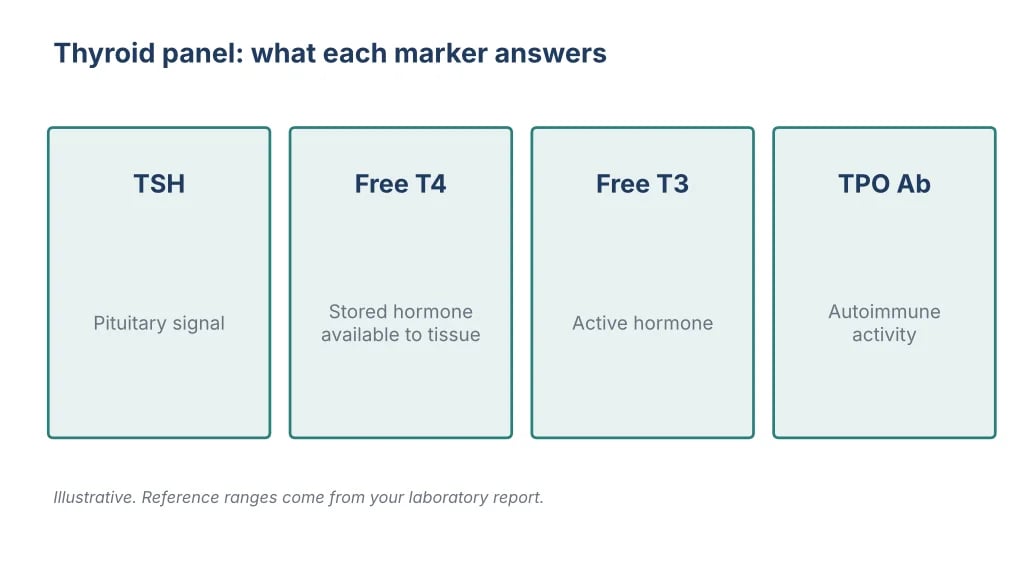
Many conditions produce flushing and sweating, and a good evaluation does not assume hormones until the alternatives are considered. An overactive thyroid raises metabolic rate and causes heat intolerance, a fast pulse, tremor and weight loss, and it is among the most common reasons a patient who believes she is menopausal turns out to need something else. The practice's guide to thyroid labs beyond TSH explains why a single screening value can leave a thyroid problem unclear.
Medicines are another common cause. Antidepressants, especially the serotonergic ones, often cause sweating. Tamoxifen and aromatase inhibitors used in breast cancer treatment cause hot flashes by lowering estrogen. Opioids, some blood pressure drugs, niacin and certain diabetes medicines can all produce flushing or sweating. Alcohol dilates blood vessels, and a night of drinking can bring on sweats several hours later as it wears off.
Sleep apnea causes night sweats through repeated surges of stress hormones as breathing stops and restarts, and it is also linked to low testosterone. Anxiety and panic attacks produce heat, sweating and a racing heart that can be mistaken for flashes. Low blood sugar can cause sudden sweating and shakiness. And a short list of rare conditions, including tumors that secrete adrenaline-like substances or serotonin, cause episodic flushing, sweating and palpitations that do not respond to hormone treatment because they are not hormonal in the usual sense.
Stress hormone problems are sometimes blamed too. The practice's article on morning cortisol
Most hot flashes and night sweats are harmless in the sense that they are not dangerous, even when they are miserable. A small number are not. Drenching night sweats that come with unexplained weight loss, fevers, swollen lymph nodes, persistent cough, new pain or a feeling of general illness should be evaluated promptly. These combinations raise concern for infection, such as tuberculosis, or for lymphoma and other cancers, and they should not be assumed to be hormonal.
Sweating or flushing that arrives in dramatic episodes with a pounding heart, headache and pallor needs a different workup from a typical hot flash. So does chest pain, shortness of breath or fainting alongside the sweating. And a hot flash that starts suddenly in someone who has no obvious reason for it, such as a man in his forties with normal testosterone and no medicines, deserves a methodical look instead of a guess.
None of these possibilities is likely in any single case. The reason to mention them is that the same symptom has a wide range of causes, and treating it as hormonal without confirmation can delay the correct diagnosis.
Blood work does most of the sorting, and the specifics matter. For a man, the usual starting point is a morning total testosterone, with free testosterone and sex hormone-binding globulin to show how much is available to tissues, and an estradiol measured by a sensitive method, because routine immunoassays are unreliable at the low levels seen in men. Luteinizing hormone and follicle-stimulating hormone show whether a low testosterone originates in the testes or in the brain's signaling. Prolactin, thyroid studies, a blood count, a metabolic panel and hemoglobin A1c fill in the picture. A man on treatment needs these timed relative to his injections, because a level drawn at the peak and one drawn at the trough tell different stories.
For a woman, the panel depends on age and cycle. Estradiol, follicle-stimulating hormone and luteinizing hormone can help when interpreted with the clinical picture and timed to the cycle where there still is one. Thyroid studies, a blood count and iron stores belong in almost every evaluation because thyroid disease and iron deficiency are both common and both affect temperature regulation and sleep. Testosterone and its binding protein are measured when symptoms such as low libido, fatigue or loss of muscle suggest a deficit.
Because the causes differ, so do the answers. In a woman whose hot flashes come from the menopausal transition, hormone therapy is the most effective treatment, and the question of which type, dose and route fits her depends on her history, her family history and her own risk calculation. The comparison between absolute versus relative risk of hormone therapy and breast cancer lays out how to think about that decision, and the comparison of bioidentical and synthetic hormones explains the terms patients encounter when options are described.
For women who cannot or prefer not to use hormones, there are non-hormonal options. Certain antidepressants at low doses, gabapentin and some other prescription medicines reduce flashes in many women. A newer class of medicines acts on the neurokinin pathway described earlier, and it requires liver monitoring and a physician's oversight. Cognitive behavioral therapy and clinical hypnosis have evidence of reducing how bothersome flashes are even when frequency does not change much.
For a man whose flashes come from androgen deprivation, the options are limited, since restoring testosterone is not appropriate in most cases. Low-dose antidepressants, gabapentin and some other agents are used under the direction of his oncology team. For a man on testosterone whose flashes came after an aromatase inhibitor, the fix is often to reduce or stop the inhibitor and recheck estradiol. For a man who has recently stopped treatment, the answer may be time, or a plan to restart the testes with other medicines if fertility is the goal. For the patient with a thyroid disorder, sleep apnea or a medicine reaction, treating that problem usually ends the flashes.
A few practical measures have modest support. Dressing in layers, keeping the bedroom cool, using breathable bedding and keeping a fan nearby help at the moment of a flash. Some people find that spicy food, alcohol, hot drinks and tight rooms are reliable triggers, and avoiding them reduces frequency. Weight loss helps women with obesity whose flashes are frequent. Paced breathing, practiced slowly at the start of a flash, has some evidence of reducing intensity.
Supplements marketed for hot flashes deserve caution. Evidence for black cohosh, soy isoflavones and similar products is mixed, and some interact with medicines or affect hormone-sensitive conditions. Anyone with a history of breast cancer or clotting problems should ask a physician before taking them. Products promising to boost testosterone to eliminate flashes are especially suspect, since raising testosterone is not the right treatment for most people who have them.
Sleep is worth protecting because broken sleep worsens nearly everything else. A cool room, a consistent schedule, limiting alcohol and caffeine in the evening, and treating sleep apnea if present can reduce the cycle of night sweats, poor rest, fatigue and irritability.
The same symptom means different things at different ages. A woman of fifty-two with irregular periods and nightly flashes is most likely in the transition. A woman of thirty-two with the same symptoms needs a look at the thyroid, the pituitary and the ovaries, because early ovarian insufficiency and prolactin disorders both present this way and both have consequences for bone and fertility. A man of sixty-eight on androgen deprivation has an expected cause. A man of thirty-eight with new flashes and no medicines does not, and the search should be wider. Age does not decide the diagnosis, but it decides how hard to look for something other than the obvious.
Patients often arrive hoping that a single result will explain everything. Hormones do not behave that way. Testosterone follows a daily rhythm that peaks in the morning and falls through the day. Estradiol swings across a cycle. Both respond to sleep, stress, illness, weight and exercise. A reading on one day can be misleading in either direction.
This is why clinicians often repeat a measurement before acting on it, and why the clinical picture carries as much weight as the lab report. A man with a testosterone in the lower part of the normal range and classic symptoms may be treated differently from a man with the same number and none. A woman whose flashes are severe and whose follicle-stimulating hormone is not yet elevated may still be in perimenopause.
It also explains why treatment decisions are made jointly, with a plan to reassess. If symptoms do not improve after the first adjustment, the original diagnosis should be reconsidered, not the dose escalated endlessly.
The most useful preparation is information. Bring your diary, a complete list of medicines and supplements with doses and start dates, and any previous lab reports. If you take testosterone, note the date and time of your last injection and the day of each blood draw. If you have stopped a medicine, record when. If you are a woman, bring your cycle history, including the date of your last period and any changes in flow or timing.
Be ready to describe your sleep, alcohol use, caffeine, weight changes and any episodes of palpitations, headache or fever. Mention family history of thyroid disease, early menopause and cancers. And say clearly what bothers you most. A patient whose main concern is broken sleep may be treated differently from one whose main concern is embarrassment at work.
At the practice, the work is organized around the physician and the individual instead of a protocol. Patients who want to talk through their symptoms can use the scheduling page to arrange a consultation with Dr. Lionel Bissoon. Men can read more about the men's health approach, and women can see how the menopause program is structured before booking.
A hot flash is a sign that the body's thermostat has been disturbed. In most women it points to the changing balance of estrogen. In most men who experience it, it points to a sudden fall in testosterone and the estradiol made from it. In a smaller group it points to something that has nothing to do with sex hormones at all.
Testosterone is part of that story but rarely the whole of it. The most productive way to approach the symptom is to resist the first explanation that comes to mind, to describe the pattern honestly, to get the right tests at the right time, and to match the treatment to the cause. When that is done, hot flashes are among the more treatable problems in hormone medicine.
Sometimes, but usually only when testosterone falls abruptly. A sudden drop, as with androgen deprivation therapy, surgery or stopping steroids, can pull estradiol down and narrow the brain's temperature tolerance. A slow age-related decline rarely does.
It can in specific situations. Hot flashes may follow stopping treatment, over-use of an aromatase inhibitor that drives estradiol too low, or swings between the peak and trough of an injection schedule. Many men on stable treatment never have them.
Not directly. High testosterone can raise estradiol through aromatization and increase heat production and sweating. Swings in estradiol, more than steadily high levels, are what tend to set off true hot flashes.
The most common reason is a rapid fall in testosterone and estradiol, as happens with treatment for prostate cancer. Medicines, thyroid problems, sleep apnea and anxiety can also cause episodes that feel the same.
Hot flashes in women are mainly driven by falling estradiol, not testosterone. Many menopausal women have low testosterone too, but treating it is aimed at libido, energy and muscle rather than at hot flashes.
Yes. Estradiol swings widely in perimenopause, and the drops can set off flashes years before periods stop. A single blood test on one day can look normal.
Thyroid overactivity usually causes constant heat intolerance, a fast pulse, tremor and weight loss, not brief episodes. A thyroid panel separates the two. Both can coexist.
For men, a morning total and free testosterone, sex hormone-binding globulin, a sensitive estradiol test, LH, FSH, prolactin and thyroid studies. For women, estradiol, FSH, thyroid studies, a blood count and iron stores, timed to the cycle where relevant.
Drenching sweats that come with fever, unexplained weight loss, swollen lymph nodes, persistent cough or new pain should be evaluated promptly. They suggest infection or other illness that is not hormonal.
Yes. Certain low-dose antidepressants, gabapentin, a newer neurokinin-targeting medicine that requires liver monitoring, cognitive behavioral therapy and clinical hypnosis can reduce hot flashes. A physician should choose among them.
Evidence is mixed, and some interact with medicines or hormone-sensitive conditions. Ask a physician before using them, especially if you have had breast cancer or clotting problems.
Do not stop on your own. Abrupt withdrawal can make symptoms worse. Talk with the prescribing physician about timing, estradiol levels and whether the dose or delivery method should change.
This page was written and medically reviewed by Lionel Bissoon, D.O., founder of Liondale Medical. Dr. Bissoon is a board-certified osteopathic physician specializing in anti-aging and concierge medicine on the Upper West Side of Manhattan.
This content is for educational purposes only and does not constitute medical advice. Individual results may vary. Consult a qualified physician before beginning any new treatment.
Published