TPE vs. Regular Blood Donation: Does Giving Blood Do Anything for Longevity?
Does donating blood do what therapeutic plasma exchange does? A claim-by-claim look at where the comparison holds up and where it breaks down.
If you are comparing longevity treatments, therapeutic plasma exchange has the strongest published case for measurable biological age reduction among the options on this list. NAD+ IV therapy is broader, less aggressive and far less expensive, which makes it a sensible entry point for many patients. Ozone therapy is better framed as a support tool for inflammation and recovery, not a replacement for plasma exchange. Stem cells, exosomes and peptides can be useful in the right context, but their evidence quality varies more than most marketing suggests. And if you have never checked baseline inflammatory markers, start there first.
| Treatment | Mechanism | Best evidence for | Cost per session | Session time | Best candidate |
|---|---|---|---|---|---|
| Therapeutic plasma exchange | Removes plasma and circulating inflammatory proteins, replaces with albumin | Biological age markers, inflammatory burden | $6,000 to $15,000 | 2 to 3 hours | Adults 50+, elevated inflammation, basics already in place |
| NAD+ IV therapy | Replenishes a coenzyme in cellular energy metabolism | Energy and cognitive support | $200 to $600 | 1.5 to 4 hours | Lower-cost starting point for energy, focus, recovery |
| Ozone therapy | Controlled ozone exposure triggers oxidative signaling | Localized inflammation, pain, immune support | $100 to $300 | 30 to 60 minutes | Inflammatory complaints needing a supportive therapy |
| Stem cells and exosomes | Regenerative signaling for tissue repair | Orthopedic and targeted regenerative uses | $1,000 to $10,000+ | 45 to 120 minutes | Specific orthopedic or regenerative goals |
| Peptide therapy | Signaling peptides for growth hormone release, repair, sleep | Recovery, sleep, metabolic support | $200 to $600 per month | Ongoing plan | Layered protocols needing incremental support |
Cost ranges are approximate and based on published clinic pricing and industry benchmarks as of 2026. TPE pricing at Liondale is discussed at consultation. See our NYC TPE cost guide for a full breakdown.
TPE is the most aggressive option on this list, which is why it gets attention. Plasma is removed and replaced with albumin, which clears inflammatory proteins and circulating waste rather than adding something to the bloodstream. It is a medical procedure, not an upgraded IV.
The strongest human data comes from Fuentealba et al., published in Aging Cell in May 2025, a randomized, placebo-controlled trial of 42 adults over 50. TPE plus IVIG produced an average 2.61-year reduction in biological age markers, and TPE alone produced 1.32 years. That should get your attention. It should not switch off your judgment. See our review of the 2025 TPE clinical trial evidence.
This is the option I point to when a patient says, “I want the treatment with the clearest signal, even if it is the most involved.” Best candidates are usually adults over 50 with elevated inflammation, slower recovery or persistent fatigue who already have the basics dialed in. It is not for patients with active bleeding disorders, significant clotting issues or albumin allergy, and it needs careful review if you take anticoagulants. At Liondale, TPE includes pre- and post-session lab tracking, Dr. Bissoon’s oversight and a Circulate-informed protocol. Most patients start with a three- to six-session initial series. Read who should and should not have TPE before deciding.
Patients sometimes ask whether TPE or IVIG is better. They are not substitutes. TPE removes and replaces plasma. IVIG (intravenous immunoglobulin) is an infused antibody product. In the 2025 trial, the arm combining the two showed the largest biological age effect, but IVIG is a separate treatment with its own contraindications, including IgA deficiency, and adds cost. At Liondale, whether IVIG belongs in a protocol is decided patient by patient, not added by default.
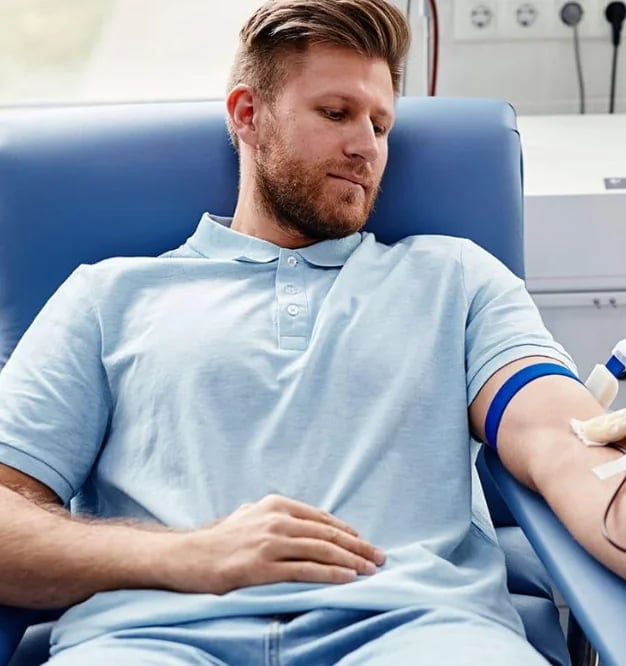
Donating blood removes whole blood, mainly red cells and iron, and does not exchange plasma proteins in the same way. The effects and risks are different. Our article on TPE versus blood donation explains the comparison in detail.
“Blood oil change” is a lay phrase that some clinics apply to more than one treatment. TPE removes and replaces plasma. EBO2 (extracorporeal blood oxygenation and ozonation) is a different procedure in which blood is circulated outside the body and treated with oxygen and ozone before being returned. It does not replace plasma. The evidence, mechanism and risks are not interchangeable, so ask any clinic exactly what procedure it is performing. For more, see our page on EBO2 therapy in NYC.
NAD+ is easier to understand once you stop treating it like a miracle product. It is a coenzyme involved in cellular energy metabolism, mitochondrial function and sirtuin activity tied to DNA repair pathways, and levels decline with age. IV delivery bypasses the gut, which is one reason clinics use it in higher-dose longevity programs, though whether every person needs IV dosing is a separate question.
The human evidence is more modest than for TPE. There is strong mechanistic rationale, strong animal data and a lot of clinical interest around energy, mental clarity and recovery, but no large randomized trial comparable to the 2025 TPE study showing biological age reduction of the same kind. That makes it different, not weak, and often a better first step for patients who want broader support without starting with the most intensive procedure.
NAD+ is a reasonable entry point if budget matters, if your main complaints are energy and focus, or if you want to build gradually. It layers well with TPE, and we often use NAD+ IV therapy between more intensive treatments. If you are choosing between IV options, read NAD+ IV therapy versus a vitamin drip.
Ozone therapy tends to be explained badly, either oversold as a cure-all or dismissed too quickly. Medical ozone uses controlled exposure to trigger oxidative signaling that may support oxygen utilization, inflammation control and recovery pathways. That mechanism is not the same as clearing old plasma from the body.
The evidence is strongest in wound care, some pain conditions and selected inflammatory or immune-related problems, and much weaker when sold as a standalone answer to systemic aging. For the right person it can be useful, especially with localized inflammation, pain or immune support needs. I would not position ozone as a substitute for TPE. I would position it as a lower-cost supportive treatment beside TPE or NAD+. Liondale offers medical ozone therapy for that reason, at roughly $100 to $300 per session.
This is where patients need the most skepticism, not because the category is useless, but because claims vary wildly from clinic to clinic. The basic idea is regenerative signaling and tissue repair. In orthopedic and targeted regenerative settings that can be compelling. In the broader world of “systemic age reversal,” a phrase to treat carefully, the evidence is thinner than the marketing usually admits.
If a clinic says stem cells will reverse whole-body aging with one treatment, ask for the trial data. Product quality, source material and regulatory status vary. There is a place for this category when the goal is targeted regenerative support, such as joint concerns, and Liondale’s regenerative medicine program fits in that lane. Cost ranges from about $1,000 to well above $10,000, so the burden of proof should rise with the price.
Peptide therapy sits between mainstream longevity medicine and the faster-moving compounding world. Peptides are signaling molecules, and protocols may target growth hormone secretion, tissue repair, sleep, metabolism or recovery depending on the compound. That breadth is part of the appeal and part of the problem.
The evidence base is mixed. There is strong community use and patient-reported benefit around sleep, recovery and training resilience, but large randomized human trials are limited, and some peptides sit in a regulatory gray area when compounded. I do not frame peptides as the anchor treatment for someone chasing the strongest proof. I frame them as tools that may sharpen a larger plan. Cost usually lands around $200 to $600 per month. For the evidence review, see peptide therapy and longevity.
These are medications, not procedures, and they work through different mechanisms and carry different risks. They may or may not be relevant to you, and they are prescribed decisions. We discuss where they fit alongside plasma exchange in rapamycin, metformin and TPE and in our overview of GLP-1 drugs and longevity.
Here is the decision framework I use most often in consults.
| If your situation is… | Consider starting with… |
|---|---|
| Reversing measurable biological aging markers with the strongest trial evidence | TPE |
| Cellular energy and cognitive support at a lower-cost entry point | NAD+, then reassess TPE after tracking your response |
| Localized inflammation, pain or immune issues | Ozone as an add-on, not a replacement |
| Building a fuller protocol on a TPE plus NAD+ foundation | Peptides or regenerative treatments, selectively |
| Never tracked baseline inflammatory markers or biological age | Labs first |
| Budget is a real constraint | NAD+ or ozone; TPE as an anchor when you are ready |
There is no prize for picking the most expensive protocol first. There is also no point doing the cheapest option forever if your data are pointing somewhere else. Not sure where you sit? Our overview of concierge longevity medicine in NYC explains how a physician-led plan is built.
Many patients who are serious about longevity medicine do not pick one treatment and stop. The sequencing Dr. Bissoon sees most often is TPE as the anchor intervention, NAD+ between sessions for energy and recovery, and ozone when inflammation or immune issues are part of the picture. That combination is a patient-specific choice, not a default stack.
TPE handles the mechanical plasma clearing. NAD+ addresses cellular energy. Ozone can support inflammation and recovery. Peptides or regenerative treatments may come later, once the baseline is clearer and the data suggests a specific gap. The right mix depends on your labs, age, medications, tolerance for procedure time and how aggressive you actually want to be. Some patients want the strongest protocol the evidence can justify, and others want a smarter on-ramp.
Choosing among these options is only half the decision. The other half is order and timing. Treatments that place real demands on your system, such as plasma exchange, are best given when you are well rested, well hydrated and not recovering from something else. Gentler supports, such as NAD+ or ozone, are often scheduled around them. Hormone and metabolic problems are usually addressed early, because they influence energy, sleep and recovery, which in turn affect how you tolerate everything else. Regenerative and peptide options tend to come later, once the baseline is clearer. Whatever the sequence, each step should have a reason and a measurement attached to it. If a clinic proposes several treatments at once without explaining why, ask which one is expected to do what, and how you will know. A well-built plan can be paused, changed or dropped when the data says so. For an overview of how one physician coordinates this kind of plan, see concierge longevity medicine in NYC.
If the question is which has stronger published evidence for measurable biological age reduction, TPE leads right now. If the question is which is easier to start, lower cost and useful for energy or cognitive support, NAD+ may be the better first move. They are not direct substitutes.
No. TPE removes and replaces plasma, while IVIG is an infused antibody product. They can be combined, as in the 2025 trial, but each has its own risks and IVIG is evaluated separately.
Yes, and that is common at Liondale. TPE can serve as the anchor treatment while NAD+ IV therapy is used between sessions for energy and recovery. Timing matters and is based on your labs, goals and tolerance.
For many patients NAD+ IV therapy or ozone therapy, which cost far less than TPE. Baseline lab work first is still wise, because a cheaper treatment is only a bargain if it fits the problem.
They may have value in specific regenerative or orthopedic contexts, but evidence for broad systemic anti-aging claims is much weaker than many clinics imply. Product quality and regulatory status vary. Ask to see human trial data before committing.
Start with labs and a real consultation. If you want the most intensive evidence-led option and your workup supports it, TPE is the clear candidate. If you want a lower-cost start, NAD+ or ozone can make sense first.
Some patients notice changes in energy, clarity, recovery or pain within days to weeks, depending on the treatment. Biomarker movement may take longer and should be checked rather than assumed. TPE is best judged across an initial series, not one session.
The phrase is a lay description of plasma exchange, but some clinics use it for other treatments such as EBO2 that do not replace plasma. Ask exactly which procedure is being performed.
TPE has the strongest controlled human evidence on this list for biological age marker reduction, based on the 2025 randomized trial in adults over 50. The evidence is still early and does not cover long-term outcomes.
It depends on labs and appetite for intensity. Many new patients are guided toward either TPE as the anchor with NAD+ and ozone layered around it, or NAD+ as the start with TPE added later if the picture supports it. The goal is to match the plan to the patient.
To talk through which option fits, schedule a consultation with Dr. Bissoon read about therapeutic plasma exchange at Liondale or compare NYC TPE clinics.
Published