Thyroid Labs Beyond TSH: The Panel a Longevity Physician Reads Before Making a Call
A TSH result alone can miss thyroid problems. Learn which thyroid tests a longevity physician reviews, how to read them, and when antibodies matter.
Most people who have had a physical in the last few years have had a lipid panel. It usually reports total cholesterol, LDL cholesterol, HDL cholesterol and triglycerides, and it may be followed by a calculated risk score. What it almost never reports is lipoprotein(a), usually written as Lp(a). That omission matters, because Lp(a) is one of the strongest inherited contributors to heart attacks, strokes and aortic valve narrowing, and a person can have a normal LDL number and still carry substantially higher risk.
This article explains what Lp(a) is, why it is largely determined by genetics, who should consider testing, what the result means and how it fits into a broader longevity and cardiovascular picture. I am writing it from the perspective of our practice in New York City, where many of our patients already track their biomarkers closely and want to know which numbers their standard physical missed.
Lipoprotein(a) is a cholesterol-carrying particle that looks very similar to LDL, the particle commonly called bad cholesterol. The difference is an extra protein attached to it called apolipoprotein(a). That protein is produced by the liver, and the blueprint for it comes from a gene called LPA. Because the instructions are written in your DNA, your Lp(a) level is set largely by the genes you inherited from your parents. A broader view of how inherited markers fit into a full plan is in our guide to building a personalized longevity plan.
This is what makes Lp(a) unusual among cardiovascular risk markers. LDL rises and falls with diet, exercise, weight, medication and age. Lp(a) concentration changes very little across most of adult life. A person who has a high level at age 30 will usually still have a high level at age 60, regardless of how well they eat or how hard they train.
Lp(a) appears to promote cardiovascular disease through several routes at once. The particle carries cholesterol into artery walls, it contains an oxidized phospholipid component that is thought to promote inflammation, and the apolipoprotein(a) portion resembles plasminogen, a protein involved in breaking down clots. Taken together, these features are believed to encourage plaque formation and make clots more likely to form or persist. The exact balance among these mechanisms is still being studied, but the association between high Lp(a) and cardiovascular events is consistent across large population studies.
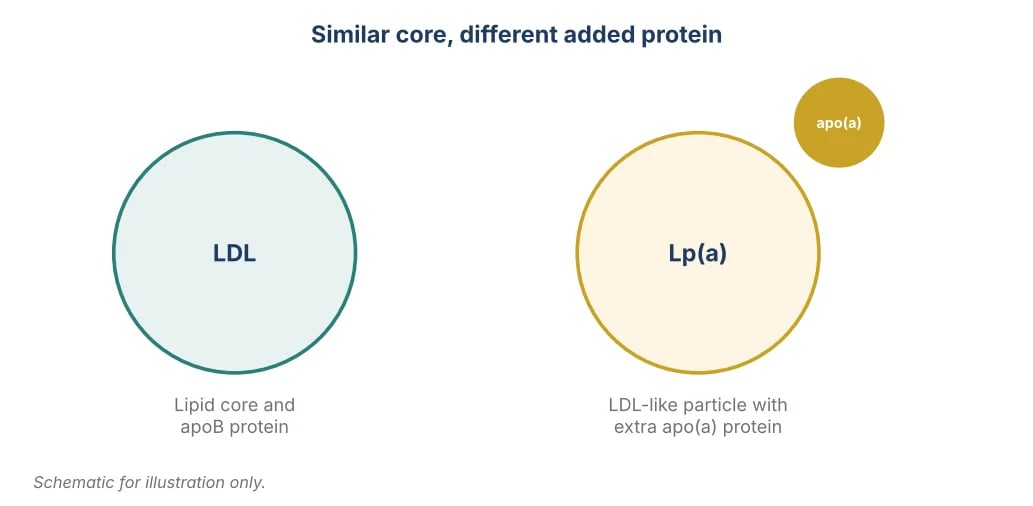
Lp(a) compared with LDL particle structure (illustrative)
Standard primary care labs were built around the LDL-based model of heart disease that dominated medicine for decades. Lowering LDL with statins remains the foundation of prevention, and a standard lipid panel does a reasonable job of showing whether LDL is controlled. Lp(a) was not part of that routine. Many insurers and standard panels do not include it, and it is often considered an optional extra. For a side-by-side look at what routine labs cover and what they leave out, read standard labs versus precision diagnostics.
The result is a common blind spot. A patient may be told their cholesterol is fine, feel healthy, exercise regularly, eat well and never hear the word lipoprotein(a) from anyone. Meanwhile, their inherited risk may be meaningfully higher than their LDL suggests. This is particularly frustrating for people who have already done everything right, because the risk comes from a factor they cannot change through lifestyle alone.
In our practice, we often see this gap when patients bring in outside lab reports as part of a longevity review. The panels look reassuring until we look at what was left out. Lp(a) is one of the most common of those omissions, along with ApoB, a measure of the total number of atherogenic particles, and a family history that was never asked about in detail.
Lp(a) levels vary enormously between people. Population studies suggest that roughly one in five adults has an elevated level, usually defined as above about 125 nmol/L or roughly 50 mg/dL. Levels are not evenly distributed by ethnicity: some groups carry higher average levels, and the distribution differs between populations. Because the variation is so wide, a single average value tells you little about an individual. The only way to know your own level is to measure it.
Think of Lp(a) as a fixed background setting rather than a score you earn. Two people who eat identically can have levels that differ several-fold. A person with a very low level has a different baseline from a person with a very high one, even if they share the same LDL and the same blood pressure.
Several professional societies have recommended that every adult have their Lp(a) measured at least once in their lifetime. The European Atherosclerosis Society and the European Society of Cardiology made that recommendation in 2019, and the National Lipid Association has issued similar guidance more recently. Because the level is stable, a one-time measurement is generally considered sufficient for most people, although the test may be repeated in specific clinical situations. Patients who want to know who will review their results can learn about Dr. Lionel Bissoon and his approach.
Testing is especially worth considering in the following situations:
You have a family history of early heart attack, stroke or sudden cardiac death, particularly in a parent or sibling under about 55 for men or 65 for women. A family history of elevated Lp(a) is a strong reason to test, because the gene is passed from one generation to the next.
You have a personal history of cardiovascular disease, even if your LDL is at goal. In that situation, knowing whether Lp(a) is elevated can change how aggressively other risk factors are managed.
You have a family history of calcific aortic valve disease, since elevated Lp(a) is linked to narrowing of the aortic valve as well as to arterial disease.
You are building a longevity or precision prevention plan and want to see the inherited part of your risk. Lp(a) belongs in that conversation alongside ApoB, inflammatory markers and a detailed review of your blood pressure, glucose and body composition.
You have already been told your LDL is normal but are carrying other risk factors, such as high blood pressure, prediabetes or a strong family pattern of heart disease.
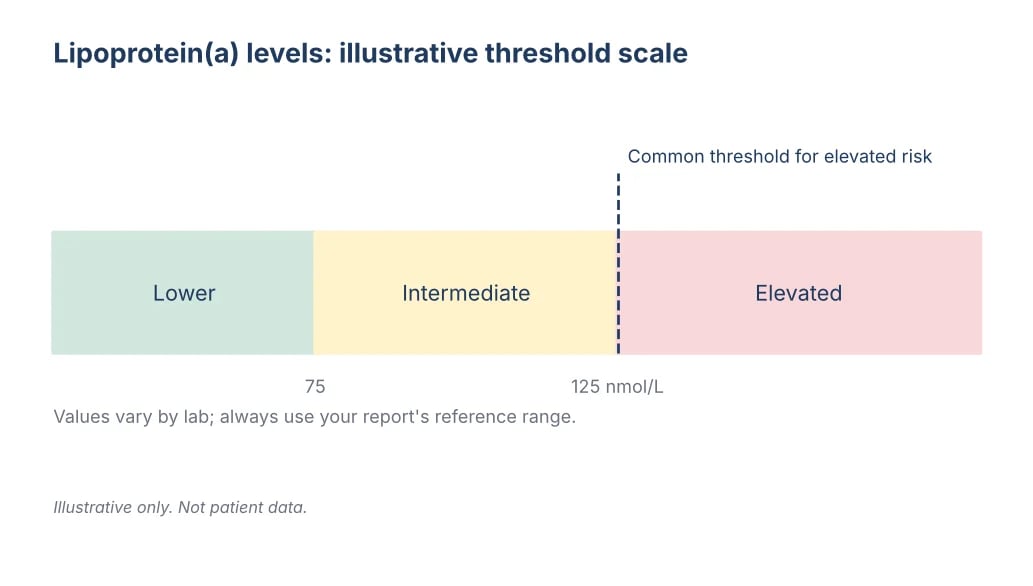
Lipoprotein(a) threshold scale (illustrative)
Lp(a) is reported in either nanomoles per liter (nmol/L) or milligrams per deciliter (mg/dL). The two units cannot be converted with a simple multiplier because the apolipoprotein(a) component varies in size from person to person, so it is important to know which unit your laboratory uses and to compare results against the correct reference range. Other markers that help interpret a cardiovascular picture are covered in which biomarkers actually predict healthspan.
Broadly, values below about 75 nmol/L are considered low to moderate, values from about 75 to 125 nmol/L are in an intermediate zone that deserves attention, and values above about 125 nmol/L are considered elevated. Some clinicians use 180 nmol/L or higher as a level associated with markedly higher risk. These thresholds are guidance, not rigid boundaries, and the interpretation should always be made in the context of your other risk factors.
A high result does not mean you will have a heart attack. It means that your background risk is higher than average and that your other risk factors deserve more careful attention. It also means that the usual prevention targets may need to be more ambitious. For example, a physician may choose to lower LDL further in someone with elevated Lp(a) than in someone with the same LDL and normal Lp(a).
Because Lp(a) is genetically determined, lifestyle changes do not lower it in any meaningful way. That is the most important thing to understand about this marker, and it is the reason many people find the result frustrating at first. However, a high Lp(a) does not leave you without options. The priority shifts to managing everything else that you can influence. Because blood sugar is one of the modifiable factors, our article on continuous glucose monitoring for non-diabetics may also be useful.
Start with the modifiable risks. Blood pressure should be measured accurately and treated to target if it is high. Blood glucose and HbA1c should be checked, since prediabetes and diabetes multiply cardiovascular risk. Smoking, if present, should be stopped. Physical activity, sleep quality, alcohol intake and body composition all influence the overall risk picture.
Next, look at LDL and ApoB. If your LDL is above goal for your overall risk, a physician may recommend a statin or another lipid-lowering medication. Some patients with elevated Lp(a) reach LDL targets that are lower than the general population standard, because their baseline risk is higher. The decision should be individualized and made with a clinician who reviews your full profile.
Finally, keep an eye on the research. Several medicines designed specifically to lower Lp(a) have been studied in large clinical trials. As of this writing, these therapies are not yet widely available as routine treatment, and the results of the largest trials are being reported in stages. Anyone with an elevated result should ask their physician what the current options are, since the landscape is changing.
Lp(a) is one part of a much larger picture. A thorough cardiovascular assessment usually includes a full lipid panel with LDL, HDL and triglycerides, ApoB, Lp(a), a marker of inflammation such as high-sensitivity C-reactive protein, fasting glucose or HbA1c, and a review of blood pressure readings over time. Depending on the patient, we may also look at kidney function, liver enzymes and thyroid function, since these affect how lipids behave. Who interprets the panel matters, and our comparison of physician-led and nurse-led longevity clinics explains the difference.
It helps to think in terms of inherited versus modifiable risk. Lp(a) represents the inherited layer. Blood pressure, glucose, smoking, body composition and LDL represent the layers you can change. The purpose of a comprehensive panel is to know both layers clearly, so that the plan is based on your actual risk rather than on a single number.
The same logic applies to people who are not yet worried about heart disease. A young adult with an elevated Lp(a) has the opportunity to build protective habits early, and a middle-aged adult with an elevated result can use the information to decide how carefully to manage other factors. Testing early generally gives more options than testing after a cardiac event.
Lp(a) is measured with a simple blood draw. It does not usually require fasting, which is one reason it can be added to a routine panel without disrupting your schedule. Results typically come back within several business days, depending on the laboratory. Some patients prefer to combine the draw with other longevity labs so that everything is reviewed in one consultation. Preparation rules vary by test, and why some blood panels need to be fasted and others don't covers the details.
Because the level is stable, there is no need to repeat the test every year unless your physician has a specific reason. If you have had a result that was close to a threshold, or if you are starting a treatment that could change related markers, your physician may recommend repeat testing at a defined interval.
Several myths circulate about Lp(a), and they can lead people to make the wrong decisions. The first is that a high Lp(a) means you must have a heart condition already. It does not. Most people with an elevated level have no symptoms and no known disease. The second is that diet can fix it. Diet can improve many cardiovascular markers, but it does not meaningfully move Lp(a) for most people. The third is that a normal LDL means you are protected. LDL is important, but it does not capture the risk carried by Lp(a). Many patients also wonder what happens after the draw, which is explained in what happens to your blood sample after an IV nutrient draw.
A fourth misconception is that a single high result is a diagnosis. In fact, a clinician will usually interpret the result alongside your history, family pattern, blood pressure, lipid profile and other markers. The number is one input, not a verdict. Finally, some people assume that because a test is available online, it can replace a clinical review. Results are more useful when someone who knows your history explains what they mean.
If you are considering this test, bring a short list of questions to your appointment. Ask whether the test is part of your current panel and whether it is covered by your insurance. Ask which units your laboratory reports, and what reference range it uses. If the result is elevated, ask how it changes your target LDL, whether a repeat test is needed and whether any family members should be informed or tested. Ask what you can do about your other risk factors right now, and what research is ongoing that could affect your options in the future.
Lipoprotein(a) is one of the clearest examples of why a standard physical is not the same as a complete cardiovascular assessment. It is inherited, stable, often overlooked and genuinely important. The good news is that it is simple to measure. The better news is that knowing about it lets you manage the rest of your risk with much more precision. If you would like to talk through your own results, you can request a consultation with our team.
If you have a family history of early heart disease, or if your annual labs have never included this marker, it is a reasonable question to raise at your next visit. At Liondale Medical, we review Lp(a) as part of a broader precision diagnostics assessment, and we explain what the result means in plain language before recommending any next step. You can request a consultation to talk through your results and your risk, whether or not you decide to test.
Heart disease rarely starts at one moment. Plaque builds in the artery wall over decades, often without symptoms, and the process is shaped by how much cholesterol-carrying particle is circulating, how the arteries respond to pressure and inflammation, and how the blood handles clotting. Lp(a) matters because it touches several of these processes at once. Its cholesterol load adds to the particles entering the artery wall, its oxidized phospholipid component is thought to encourage inflammation, and its apolipoprotein(a) portion may interfere with the body's normal ability to break down clots.
Because the effect accumulates over time, the age at which a person learns their level can matter. A young adult who knows their Lp(a) is high has many years to lower other risk factors, to keep blood pressure in a healthy range and to track their LDL and ApoB. A person who learns of an elevated level after a heart attack has the same information but fewer options to act on it before the next event. That is one reason we treat a one-time test in early adulthood as a worthwhile investment, even for people who feel healthy.
Lp(a) also helps explain a pattern that many clinicians recognize: patients who have a heart attack despite a low LDL and a healthy lifestyle. Some of these patients have an elevated Lp(a) that was never measured. The lesson is not that LDL no longer matters. It is that a single lipid number can hide a second, independent route to risk.
Because Lp(a) is inherited, a high result is also information about relatives. Parents, siblings and children share a meaningful portion of the same genetic pattern, so an elevated level in one person may signal a higher risk in others. Many people find this the most emotionally complicated part of the result. They may feel guilt, worry or frustration, or they may not know how to raise the subject with family members who prefer not to talk about health.
A practical approach is to share the result in plain terms: that a specific inherited cholesterol marker is higher than average, that it is measured with a simple blood test, and that relatives may wish to ask their own physicians about testing. It is helpful to bring along any relevant family history of early heart attack, stroke, sudden cardiac death or aortic valve problems, since these details help a relative's clinician decide how urgently to act. We are happy to provide a short summary that patients can share with family or with their own doctors.
An elevated Lp(a) result is most useful when it becomes part of a documented plan. The plan usually includes a summary of your overall risk, the targets for LDL and blood pressure that your physician has set, the timing of any repeat blood work, and the criteria that would prompt earlier review, such as new chest discomfort, shortness of breath with exertion, or symptoms of stroke. It should also say who is responsible for each step, so that the result does not disappear into a patient portal.
Many patients benefit from a dedicated follow-up visit to review the result, rather than receiving it through a message alone. In that conversation, we explain the difference between inherited and modifiable risk, answer questions about the numbers, and agree on the next steps. We also ask about goals, since some people want to make the most ambitious changes possible, while others prefer a gradual approach that fits their work and family life.
A blood marker is one way to assess heart disease risk. For some patients, a clinician may also recommend additional tests to see whether plaque is already present. A coronary artery calcium score is a non-contrast scan that measures calcified plaque in the coronary arteries, and it is often used to help decide whether preventive medication is needed in people at intermediate risk. Other patients may need an echocardiogram if there are concerns about the aortic valve, particularly when a family history of valve disease is present.
Imaging is not automatically needed for everyone with an elevated Lp(a). The decision depends on age, symptoms, family history, blood pressure, smoking status, diabetes and other findings. The value of these tests lies in helping the clinician and the patient decide how aggressively to act, and they should be discussed as part of the overall plan rather than ordered in isolation.
Even though lifestyle does not reliably change Lp(a) levels, it remains the foundation of heart health. Regular aerobic activity improves blood pressure, insulin sensitivity and cardiovascular fitness. Strength training supports body composition and metabolic health. A diet built around vegetables, legumes, whole grains, fish and unsaturated fats is associated with better cardiovascular outcomes across many studies, while diets high in ultra-processed foods and added sugars are associated with worse ones. Sleep matters as well, since short or disrupted sleep is linked to higher blood pressure and worse glucose control.
Tobacco use is the single most important modifiable risk for many people, and stopping smoking produces measurable benefits for the heart and blood vessels within months. Limiting alcohol, maintaining a healthy weight and managing stress also contribute. None of these changes erases an inherited risk, but together they reduce the total burden, which is the goal of a sensible prevention plan.
A complete review at our practice looks at several layers of information. We start with the personal history and family pattern, including any early cardiac events, strokes, diabetes, kidney disease or valve problems in relatives. We measure blood pressure carefully, sometimes with home monitoring to confirm readings. We review the full lipid profile and add ApoB and Lp(a) where appropriate. We check glucose control, kidney function and inflammatory markers when they are relevant. We also discuss medication history, since some drugs affect cholesterol and blood pressure.
From that information, we build a risk picture and decide what to measure next and what to change first. This approach avoids the common trap of treating one number in isolation, and it gives patients a clear sense of which factors matter most for them personally.
Patients sometimes ask whether a result can be trusted if it was drawn during an illness or after a large meal. Lp(a) is less affected by short-term diet than triglycerides, so fasting is usually not required, but acute illness and some medications can influence related lipid results. If a result seems out of step with the rest of the panel, a repeat measurement or a conversation with the ordering clinician is a sensible next step.
Patients also ask how a single result can be used over many years. Because the level is stable, the main reasons to retest are a change in the clinical situation, a borderline initial value, or a decision to start a new therapy that might alter related markers. Otherwise, the most useful information is the context you carry forward: the number, the date, the units and the reference range used by the laboratory.
If you are planning to discuss Lp(a) with your physician, a little preparation makes the visit more productive. Gather your last two or three lipid panels, including the dates and laboratory names, so that trends are visible. Write down any family history you know about, including the age at which relatives had heart attacks, strokes, valve surgery or sudden cardiac events. List your current medications, supplements and any blood pressure readings you have recorded at home. Note your smoking, alcohol and exercise habits honestly, since they shape the plan. Finally, decide in advance which outcome you would find most useful: a clear answer on whether testing is needed, a summary to share with relatives, or a plan that addresses all your risk factors at once.
Lipoprotein(a), or Lp(a), is a cholesterol-carrying particle similar to LDL but with an additional protein called apolipoprotein(a). Its level is set largely by genetics and is an independent contributor to heart attack, stroke and aortic valve disease risk.
Usually not. Most standard lipid panels report LDL, HDL, total cholesterol and triglycerides. Lp(a) is typically ordered separately or added as a specific test, which is why many people never learn their level.
For most people, diet and exercise do not meaningfully change Lp(a). They remain important for managing blood pressure, glucose, LDL and overall cardiovascular risk, which are the factors you can influence.
Because the level is largely stable, most adults need to test only once. Your physician may recommend repeat testing if a previous result was borderline, if you are starting a treatment that affects related markers, or if your clinical situation changes.
Values above about 125 nmol/L, or roughly 50 mg/dL, are generally considered elevated. Some clinicians use 180 nmol/L or higher to identify markedly elevated risk. Interpretation depends on the laboratory and on your other risk factors.
No. An elevated level means your inherited background risk is higher than average. Many people with high Lp(a) never have a cardiac event, particularly when blood pressure, glucose, LDL and other risk factors are well managed.
Lp(a) is inherited, so if you have an elevated level, a physician may recommend testing first-degree relatives. The decision depends on family history, age and the individual's other risk factors, and should be made with a clinician.
Standard statins do not lower Lp(a) in a meaningful way. Several investigational medicines designed to lower it have been studied in large trials. Their availability and status change over time, so ask your physician about the current options.
Coverage varies by plan and by the reason for testing. Some insurers cover it when there is a personal or family history of cardiovascular disease. Our team can help you understand the options before you book.
ApoB measures the total number of atherogenic particles in the blood, including LDL and Lp(a). Both markers add useful information. Looking at them together gives a more complete picture of cardiovascular risk than either one alone.
This page was written and medically reviewed by Lionel Bissoon, D.O., founder of Liondale Medical. Dr. Bissoon is a board-certified osteopathic physician specializing in anti-aging and concierge medicine on the Upper West Side of Manhattan.
This content is for educational purposes only and does not constitute medical advice. Individual results may vary. Consult a qualified physician before beginning any new treatment.
Published