10-Pass Ozone Therapy Explained: What Actually Happens During Treatment
What a 10-pass ozone therapy appointment is actually like, step by step: preparation, the session itself, how it feels, and what happens right after.
Search "ozone therapy" in New York and you'll eventually run into a term that looks like a typo the first time you see it: EBO2. It isn't a typo. It's a specific, well-defined technique, and understanding what sets it apart from more familiar ozone protocols is worth doing before deciding whether it's the right fit for you. At Liondale Medical on the Upper West Side of Manhattan, Lionel Bissoon, DO, offers EBO2 as one option within a broader toolkit of ozone-based treatments.
EBO2 stands for extracorporeal blood oxygenation and ozonation. Each part of that name describes a real step in the process. Extracorporeal means the treatment happens outside your body, your blood leaves, gets processed, and returns. Blood oxygenation means enriching that blood with oxygen. Ozonation means infusing it with medical-grade ozone. Put the three together and you get a technique that pulls blood out, saturates it with both oxygen and ozone simultaneously, and sends it back into circulation.
If you've come across our earlier piece on 3 reasons to consider ozone therapy, you'll recognize the broader family EBO2 belongs to. That piece covers ozone therapy at a general level, several delivery methods, the underlying rationale, common conditions treated. This page goes deeper into one specific method within that family, since patients researching EBO2 by name usually want more detail than a general overview provides.
Ozone therapy itself isn't new. German field hospitals used it for wound disinfection during World War I, a full century before antibiotics existed as an alternative. European medicine kept developing the practice over the following decades, eventually formalizing protocols still used today. EBO2 represents a more recent branch of that same tree, developed as practitioners looked for ways to increase the total therapeutic exposure achievable in a single session. It didn't replace older methods so much as it joined them, another tool suited to specific situations rather than a universal upgrade to everything that came before it.
Understanding this history matters for a practical reason. A treatment with a century of accumulated clinical use behind it, even one that sounds unfamiliar by name, is a fundamentally different proposition than something genuinely experimental. EBO2 is a refinement built on decades of established ozone medicine, not a brand-new, untested concept dressed up in technical language.
Both EBO2 and the 10-pass method, the more established, widely known technique, process blood outside the body using medical-grade ozone. Where they diverge is in mechanics. The 10-pass method draws a fixed, relatively modest volume of blood and cycles it through an ozone mixing chamber ten separate times within one session. EBO2 instead runs a continuous circuit, moving a substantially larger total volume of blood through simultaneous oxygenation and ozonation rather than cycling a smaller amount repeatedly.
The practical upshot: EBO2 exposes more total blood volume to therapeutic ozone and oxygen levels within a single sitting. That's the whole reason it's generated interest as an option for certain patients and certain conditions. It doesn't automatically make it the superior choice, more on that shortly, but it does make it a genuinely different tool from the one most patients already know about.
The underlying mechanism is shared with ozone therapy generally. Introducing a controlled, medical-grade dose of ozone into blood triggers a beneficial oxidative response. At the doses used clinically, this appears to activate your body's own antioxidant defense systems, improve how efficiently your cells use oxygen, and support the release of growth factors tied to tissue repair. Because EBO2 processes a larger blood volume with simultaneous oxygen enrichment, the goal is a more thorough systemic exposure to all of that within one appointment, rather than requiring multiple smaller sessions to reach a similar cumulative effect.
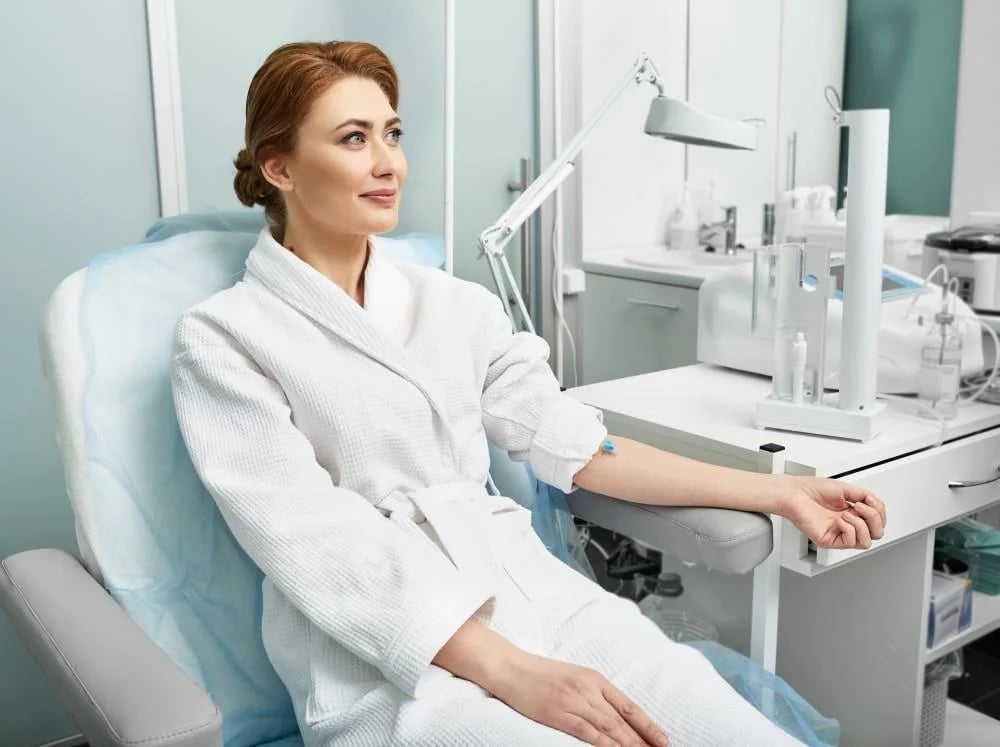
An EBO2 appointment starts the way most blood-based treatments do. Blood is drawn through an IV line and routed through a closed, sterile system, simultaneously enriched with medical-grade oxygen and ozone, then returned to your body through the same line. Because EBO2 works through a continuous circuit rather than discrete passes, sessions run longer than a standard 10-pass appointment, typically 45 minutes to an hour and a half depending on the specific protocol and your individual factors. You stay seated the entire time. Most patients describe it as uneventful, closer to an extended blood donation than anything more intense.
EBO2 gets considered for many of the same conditions as other ozone-based treatments: chronic Lyme disease, fibromyalgia, chronic fatigue, and slow-healing wounds appear regularly. Patients and providers sometimes lean toward EBO2 specifically for more systemic, whole-body concerns, where processing a larger blood volume in one sitting may offer more thorough exposure than a smaller-volume protocol. Patients managing longstanding chronic illness who haven't seen the results they hoped for from a standard-volume ozone protocol sometimes explore EBO2 as a next step, though this decision gets made individually with Dr. Bissoon rather than assumed as an automatic upgrade for anyone who's tried the 10-pass method once.
This is probably the single most common question patients bring up, and the honest answer resists a simple yes or no. Neither method is universally superior. The 10-pass method has a longer clinical track record and remains an appropriate, effective starting point for a wide range of conditions. EBO2 offers a larger total blood volume exposure in a single session, which may genuinely help certain systemic conditions or patients who haven't responded strongly to standard protocols.
Which one is right for you depends on your specific condition, how severe it is, how you've responded to any prior treatment, and Dr. Bissoon's clinical judgment after a real evaluation, not a blanket rule that one method wins in every case. Patients working through a documented case of chronic Lyme disease, a topic covered in more depth in our piece on Lyme disease and treatment-resistant symptoms, sometimes find EBO2 worth exploring once standard antibiotic treatment and an initial ozone protocol haven't fully resolved lingering symptoms.
EBO2, like other blood-based ozone therapies, is generally well tolerated when an experienced provider administers it using medical-grade equipment and sterile technique. Because it involves processing a larger blood volume over a longer session, screening matters more here than for a quick appointment: cardiovascular health, clotting status, and general tolerance for an extended IV-based procedure all factor into whether Dr. Bissoon recommends EBO2 specifically over another ozone-based option.
Patients sometimes ask whether the larger blood volume involved in EBO2 makes it inherently riskier than the smaller-volume 10-pass method. The honest answer is that volume alone isn't the primary safety factor, proper screening and administration are. A well-screened patient undergoing EBO2 under appropriate medical supervision faces a similarly favorable safety profile to a well-screened patient undergoing 10-pass treatment. The screening process itself, not the specific volume processed, is what does the real work of keeping either treatment safe.
As with other ozone therapies, session count depends heavily on what's actually being treated. A specific, time-limited concern might see meaningful improvement within a handful of visits. A longstanding chronic condition, Lyme disease or fibromyalgia among the more common examples, usually needs a longer, more sustained course spaced across weeks or months, since these conditions tend to respond better to cumulative treatment than to any single session judged in isolation. Dr. Bissoon sets realistic expectations and check-in points specific to your situation rather than quoting a generic number that applies to everyone equally.
EBO2 sessions typically run longer and process more blood volume than the 10-pass method, and cost per session tends to reflect that, the additional time, equipment use, and materials all factor in. As with everything at Liondale Medical, a specific estimate comes after your evaluation, once Dr. Bissoon has actually recommended a protocol suited to your condition, rather than being quoted generically before your situation is understood.
Most patients experience minimal to no downtime and return to normal activity the same day. Some report mild fatigue for the rest of the day, similar to what people sometimes feel after other extended IV-based treatments, and it typically resolves on its own without intervention. Staying well hydrated afterward is generally recommended to support your body as it processes the treatment. Because sessions run longer than many other in-office appointments, some patients find it easier to plan a quieter afternoon afterward rather than scheduling something demanding immediately following the visit, though this is a matter of comfort rather than medical necessity.
With several ozone-based options on the table, EBO2, the 10-pass method, direct gas infusion, and prolozone among them, the most efficient path is a comprehensive evaluation where Dr. Bissoon reviews your specific condition, history, and goals before recommending a direction, rather than starting from a preferred treatment and working backward to justify it. Patients managing testosterone or other hormone-related fatigue alongside a chronic inflammatory condition often find it useful to review our men's health services alongside their ozone therapy evaluation, since the two sometimes address overlapping symptoms from different angles.
EBO2 and other ozone-based therapies tend to work best woven into a broader treatment plan rather than treated as an isolated fix. Patients managing chronic inflammation alongside nutrient depletion frequently pair ozone therapy with our IV therapy and NAD+ services. Those balancing tissue repair needs alongside systemic inflammation sometimes explore our broader regenerative medicine offerings as a complement, since the two approaches address healing from different but related angles. And patients whose fatigue or recovery concerns connect to a broader hormonal picture often benefit from a comprehensive look through our anti-aging program as well.
Curious whether EBO2 or another ozone-based treatment fits your specific situation? Schedule an evaluation with Dr. Bissoon at Liondale Medical.
Extracorporeal blood oxygenation and ozonation, a technique that processes blood outside the body to saturate it with both oxygen and ozone before returning it to circulation.
EBO2 runs a continuous circuit processing a larger total blood volume with simultaneous oxygenation and ozonation, while the 10-pass method cycles a smaller, fixed volume through the process ten times in one session.
Neither is universally superior. They suit different situations, and Dr. Bissoon determines which fits your specific condition during an evaluation.
Sessions typically run 45 minutes to an hour and a half, longer than standard 10-pass treatments, since a larger blood volume is processed in a continuous circuit.
Chronic Lyme disease, fibromyalgia, chronic fatigue, and slow-healing wounds, similar to other ozone-based treatments, sometimes considered specifically for more systemic conditions.
Yes, Liondale Medical offers EBO2 therapy at our Upper West Side Manhattan location and sees patients from across the greater New York City area.
This page was written and medically reviewed by Lionel Bissoon, D.O., founder of Liondale Medical. Dr. Bissoon is a board-certified osteopathic physician specializing in anti-aging and concierge medicine on the Upper West Side of Manhattan.
This content is for educational purposes only and does not constitute medical advice. Individual results may vary. Consult a qualified physician before beginning any new treatment.
Published