EBO2 Therapy in NYC: How It Works and How It Differs from Standard Ozone Therapy
EBO2 is a distinct ozone technique, not a typo. Dr. Bissoon explains how it differs from 10-pass ozone, what a session involves, and who it suits.
There's a decent chance you've heard the word "ozone" mostly in the context of the atmosphere, the layer up there protecting us from UV radiation. So it can be a genuine surprise to learn that the same molecule, three oxygen atoms bonded together instead of the usual two, has a growing role in modern medicine. At Liondale Medical on Manhattan's Upper West Side, Lionel Bissoon, DO, has been using medical-grade ozone for years to help patients manage chronic conditions, speed healing, and support overall wellness, often after other approaches have hit a wall.
This isn't a fringe wellness trend dressed up in medical language. Ozone therapy has a real, if still-evolving, body of clinical use behind it, and it's become one of the more requested treatments at our practice. Here's what it actually is, why patients pursue it, and how to know if it might be worth exploring for you.
Ozone therapy isn't one single procedure, it's a family of techniques that all use medical-grade ozone gas, delivered in different ways depending on what's being treated. At Liondale Medical, we offer several methods:
The 10-pass method draws a portion of your blood, mixes it with ozone under controlled pressure inside a closed hyperbaric system, and returns it to your body, cycling this process ten times in a single session.
Direct gas infusion delivers ozone intravenously in smaller, continuous amounts rather than in discrete passes.
Direct ozone treatment applies the gas directly to a wound or affected area of skin to stimulate the healing response locally.
Prolozone injections combine ozone with other therapeutic agents, injected directly into a joint or area of chronic pain to stimulate tissue repair.
Every one of these methods is non-invasive and generally painless. None require general anesthesia, incisions, or significant recovery time, patients typically walk out and resume their day.
Compared to more invasive interventions, ozone therapy is remarkably gentle on the system. A blood-based session looks, from the patient's chair, a lot like giving blood for routine labs, just with a longer seated period while the ozone mixing and reinfusion happens. There's no anesthesia to recover from, no surgical site to protect, and for most methods, no meaningful downtime afterward. This matters more than it might sound like it should: a lot of patients who could benefit from ozone therapy are already managing a chronic illness that leaves them with limited energy reserves. A treatment that doesn't cost them a day of feeling worse before they feel better is a real practical advantage, not just a marketing point.
We don't reach for ozone therapy as a first-line treatment for minor issues. Where it earns its place at Liondale Medical is with conditions that tend to resist simpler interventions: Lyme disease, particularly the chronic, lingering version that doesn't fully resolve with antibiotics alone; fibromyalgia, with its diffuse muscle pain and fatigue that rarely responds well to any single treatment; chronic fatigue that's been investigated and doesn't trace back to an obvious cause; and joint pain or slow-healing wounds, including diabetic ulcers, where the body's own repair mechanisms need an assist.
In these situations, ozone therapy is usually part of a broader plan rather than a stand-alone fix. Dr. Bissoon coordinates it alongside whatever conventional treatment is already underway, using it to address inflammation and support the body's healing capacity rather than replacing established medical care. For patients whose recovery would also benefit from tissue repair support specifically, that plan sometimes includes our regenerative medicine services as well.
It's worth pausing on why ozone does what it does, because the explanation isn't hand-wavy. When ozone is introduced into blood or tissue, it triggers a controlled oxidative reaction. Rather than being purely damaging (which is the association most people have with "oxidative stress"), this reaction at the doses used in medical ozone therapy appears to activate the body's own antioxidant defense systems, improve how efficiently cells use oxygen, and stimulate the release of growth factors involved in tissue repair. The practical result, according to both clinical observation and a growing research base, is reduced inflammation, better circulation, and accelerated healing in the treated area or system.
None of this means ozone therapy is a cure-all, and we're careful not to present it that way. But the mechanism is a real, describable biological process, not a black box.
Patients researching ozone therapy in NYC often run into two terms that sound similar but aren't identical: the 10-pass method described above, and a newer technique called EBO2 (extracorporeal blood oxygenation and ozonation). Both process your blood outside the body and return it, but the mechanics differ. The 10-pass method cycles a fixed, relatively small volume of blood through the ozone mixing chamber ten separate times within one session. EBO2 instead runs a continuous circuit, processing a substantially larger total volume of blood through oxygenation and ozonation over the course of the treatment.
Which is right for a given patient depends on the condition being treated, its severity, and what Dr. Bissoon determines during your evaluation. We've written a separate, detailed guide to EBO2 therapy in NYC if you want to go deeper on how that specific technique works and what a session involves.
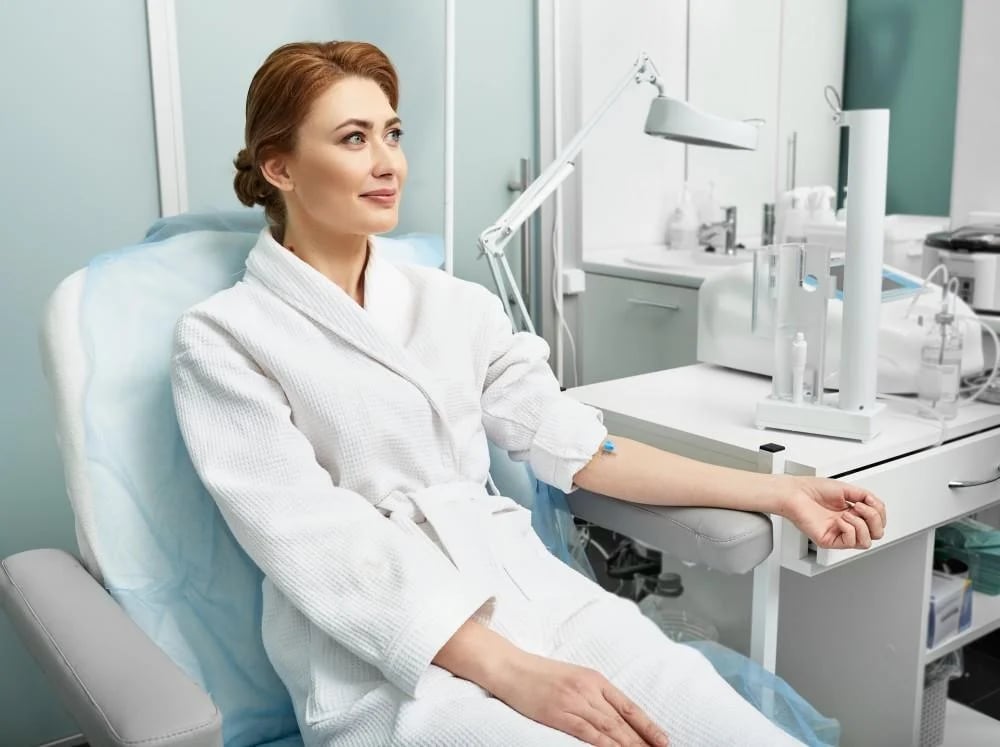
If you've never had ozone therapy, it helps to know what the actual appointment looks like, since the unfamiliarity is often the biggest barrier to trying it. You'll start with a short check-in on how you've been feeling since your last visit or, for a first appointment, a review of your symptoms and relevant medical history. For blood-based methods, a technician draws blood much like a standard lab draw, mixes it with medical-grade ozone inside a sealed, sterile system, and returns it to you through the same line. You'll be seated for the process, generally somewhere between 30 minutes and an hour depending on the method. Most people describe it as uneventful, some read, scroll their phone, or just relax. Afterward, you're free to go about your day; there's no observation period required for the majority of patients.
This is one of the most common questions we get, and the honest answer is: it depends heavily on what you're treating. A patient using prolozone injections for a specific joint issue might notice improvement within a handful of visits. Someone working through chronic Lyme disease or long-standing fibromyalgia is usually looking at a longer course, spaced out over weeks or months, because these are conditions that took a long time to develop and generally respond better to sustained, cumulative treatment than to a single session judged in isolation. Dr. Bissoon will lay out realistic expectations and check-in points specific to your situation rather than quoting a generic number.
In practice, the patients who come to us asking about ozone therapy generally fall into a few overlapping groups. There are patients with a documented chronic illness, often Lyme disease or fibromyalgia, who've already been through a fair amount of conventional treatment and are looking for something additional rather than a replacement. There are patients managing a slow-healing wound, sometimes related to diabetes, where standard wound care has stalled. There are athletes and active people dealing with joint pain or an injury that's proving stubborn. And there are patients without a specific diagnosis who simply feel like their energy, recovery, and general resilience have declined and are looking for a way to support their body's own repair processes more directly. That last group often ends up pairing ozone sessions with our IV nutrition therapy, since addressing nutrient gaps alongside inflammation tends to move the needle faster than either treatment alone.
It's worth being direct about the limits here too. Ozone therapy isn't a substitute for antibiotics in an active bacterial infection, isn't a weight-loss treatment, and isn't going to reverse a condition that has a different underlying mechanism entirely, hormone-driven fatigue, for instance, is a separate issue our bioidentical hormone therapy is built to address instead. Dr. Bissoon's evaluation exists precisely to sort out whether your specific situation is one where ozone therapy makes clinical sense, or whether something else, or something in addition, is the better fit.
Medical use of ozone isn't a recent invention dressed up for the wellness industry, it dates back over a century. German physicians began experimenting with ozone for wound disinfection during World War I, when battlefield infections were a leading cause of death and antibiotics didn't yet exist. Over the following decades, European medicine, particularly in Germany and other parts of the continent, continued to develop and refine ozone applications, eventually formalizing protocols like the 10-pass method that are still in clinical use today. The technique has been slower to gain mainstream traction in the United States, partly due to how differently medical treatments get regulated and studied here, but interest has grown steadily as more clinical data has accumulated and as patients with chronic, hard-to-treat conditions have sought out options beyond conventional first-line care. Knowing this history matters because it separates ozone therapy from treatments with no real track record; this is a modality with decades of accumulated clinical experience behind it, even if it's still relatively unfamiliar to many patients walking into our office for the first time.
Whether or not ozone therapy ends up being right for you, a few questions are worth bringing to your evaluation. Ask what specifically the provider expects to see change, and by when, so you have a concrete benchmark rather than a vague sense of "it should help." Ask how the recommended method was chosen for your particular condition, since a provider who can explain that reasoning clearly is generally one who's tailoring the treatment rather than defaulting to a standard package. And ask how ozone therapy will be coordinated with anything else you're currently doing medically, since the goal at Liondale Medical is always integration with your existing care, not a competing, disconnected treatment track.
Ozone therapy is most often used for chronic conditions that haven't fully responded to conventional treatment, including Lyme disease, fibromyalgia, chronic fatigue, joint pain, and slow-healing wounds. It's typically used alongside, not instead of, standard medical care.
When administered by a trained provider using medical-grade ozone in sterile, closed systems, ozone therapy has a strong safety record. Dr. Bissoon evaluates each patient's health history before beginning treatment to confirm it's an appropriate fit.
Cost depends on the specific method used (10-pass, direct gas infusion, prolozone, or EBO2) and how many sessions your treatment plan calls for. You'll get a personalized estimate during your evaluation.
EBO2 processes a larger, continuous volume of blood through oxygenation and ozonation, while the 10-pass method cycles a smaller, fixed volume through the process ten times in one session. Dr. Bissoon recommends the method suited to your specific condition.
Most sessions run between 30 minutes and an hour, with no meaningful downtime afterward for the large majority of patients.
Yes, Liondale Medical is on the Upper West Side and treats patients from across New York City, including Brooklyn.
Curious whether ozone therapy fits your specific situation? Schedule an evaluation with Dr. Bissoon, and we'll walk through your history and options together. Manhattan is full of wellness offerings that promise a lot and explain little; our approach is the opposite, we'd rather you leave your first visit understanding exactly why a particular treatment was or wasn't recommended for you.
Published