Lipoprotein(a): The Heart Risk Marker Your Annual Physical Probably Never Checked
Lp(a) is a largely inherited heart risk marker that most annual physicals skip. Learn who should test, what the numbers mean, and what to do next in NYC.

A man in his early fifties gets his annual physical. His cholesterol panel comes back, and the doctor is pleased: total cholesterol is acceptable, LDL is 112, which is not alarming, HDL is decent and triglycerides are reasonable. He is told to keep exercising and come back next year.
Two years later, a coronary calcium scan shows plaque. He is surprised, and so is his doctor. When someone finally measures his ApoB, it is well above the range most lipid specialists consider desirable. His LDL cholesterol was never the problem the lab said it was. The number that mattered was never on the report.
This pattern is common enough that it has a name, discordance, and a growing number of cardiologists and longevity physicians consider it one of the strongest arguments for adding ApoB to routine testing. This guide explains what ApoB is, why it can disagree with LDL cholesterol, how to read the numbers and what to do with the information.
A standard lipid panel reports four numbers: total cholesterol, HDL cholesterol, triglycerides and LDL cholesterol. Only the first three are measured directly in most labs. LDL cholesterol is usually calculated from them using a formula, such as the Friedewald equation or newer variants.
Cholesterol is a waxy substance carried in the blood inside particles called lipoproteins. The cholesterol in each particle is a cargo. The particle itself is the vehicle. A panel measures the cargo, the milligrams of cholesterol, and infers how much of it sits in LDL particles.
This works reasonably well for many people, which is why the test has been a mainstay for decades. It works less well when particles carry unusual amounts of cholesterol, when triglycerides are high or when LDL is very low. In those situations, the amount of cholesterol per particle varies, and the cargo no longer tracks the number of vehicles.
Lab reports mark results as normal or abnormal using reference ranges. A reference range is usually built from the distribution of values in a tested population, not from the level at which risk is lowest. When the population has a high rate of metabolic disease, the range that counts as normal can be uncomfortably generous. An LDL-C of 130 may print without a flag, even though many cardiologists would be uneasy about it in a person with other risk factors.
This is one reason longevity-minded clinics look beyond the flag. The practice's comparison of standard labs and precision diagnostics explains why a result can be in range and still be worth acting on. A flag tells you that a value is unusual compared with the people who were tested. It does not tell you whether it is good for you.
Apolipoprotein B, or ApoB, is a structural protein that wraps around every particle capable of causing atherosclerosis. Each LDL particle carries one ApoB molecule. So does each VLDL particle, each IDL particle, each remnant particle and each lipoprotein(a) particle. HDL does not carry ApoB.
Because there is exactly one ApoB per atherogenic particle, measuring ApoB counts the particles. It answers a different question from LDL cholesterol. LDL-C asks how much cholesterol is in LDL particles. ApoB asks how many atherogenic particles are in the blood.
The distinction matters because of how plaque forms. Particles that carry ApoB can enter the wall of an artery, where they can become trapped and trigger the changes that lead to plaque. Many researchers think the number of particles trying to cross the wall matters more than how much cholesterol each one is carrying. More particles mean more chances to be trapped.
Think of cholesterol as passengers and lipoproteins as cars. A traffic jam depends on the number of cars on the road, not on the total number of passengers. If a road carries ten thousand cars, each with one passenger, it is more congested than a road with five thousand cars, each with two passengers, even though both carry the same number of people.
LDL cholesterol counts passengers. ApoB counts cars. For most people, the two move together, because the average car carries a similar load. But some people have many cars with few passengers each. Their LDL-C looks fine, and their roads are jammed.
Consider two hypothetical patients, both with an LDL-C of 110 mg/dL. The first has an ApoB of 75, which suggests that her LDL particles are relatively large and cholesterol-rich, so the particle count is modest. The second has an ApoB of 115, which suggests that his LDL particles are smaller and carry less cholesterol each, so there are many more of them for the same cholesterol total.
On a standard panel, they look identical. Under a particle count, the second patient has about half again as many atherogenic particles. If you believe that particle number drives plaque formation, he faces a higher risk, and he is the patient whose chart is most likely to be filed under normal.
These figures are illustrative and not from any patient, but patterns like them are exactly what discordance studies describe. They are the reason a growing number of clinicians say that if they could add only one test to a standard lipid panel, it would be ApoB.
Discordance means that LDL-C and ApoB point in different directions. A person might have a modest LDL-C and a high ApoB, or the reverse. Studies of large populations show that when the two disagree, risk tends to follow ApoB more closely than LDL-C.
The patterns that produce discordance are well described. People with insulin resistance, metabolic syndrome, prediabetes or type 2 diabetes often have small, cholesterol-poor LDL particles and elevated triglyceride-rich particles. Their LDL-C may be unremarkable while their particle count is high. People with elevated triglycerides often have a similar pattern. Some people with familial combined hyperlipidemia have high ApoB with modest LDL-C.
The reverse also occurs. Some people have large, cholesterol-rich particles and a high LDL-C with a relatively low ApoB. For them, LDL-C may overstate risk.
The result is that two people with the same LDL-C can face different risks, and a person can look reassuring by one measure and concerning by the other.
Certain groups are more likely to have discordance, which is why testing ApoB in them is particularly informative.
People with insulin resistance or metabolic syndrome are the prime example. The practice has written about glucose and metabolic health in its article on continuous glucose monitoring in non-diabetics, and the same biology that produces a high glucose response often produces a lipid pattern in which LDL-C looks fine and ApoB does not.
People with high triglycerides, low HDL, central obesity or a family history of early heart disease are also candidates. So are people with type 2 diabetes, and those whose LDL-C is already low on treatment, because in that setting the calculated LDL-C is less reliable and ApoB may remain elevated.
Anyone with a strong family history of premature cardiovascular disease and a seemingly good panel has a particularly good reason to ask for a particle count.
Lipid patterns often change around menopause. Many women see LDL-C and ApoB rise in the years surrounding the final menstrual period, partly because of the decline in estrogen and partly because of shifts in body fat distribution and insulin sensitivity. Because women's cardiovascular risk is often underestimated, a rise at this stage can go unnoticed.
The practice's article on menopause and longevity medicine describes how the transition fits within a broader prevention plan. For women in midlife, a baseline ApoB before and after menopause is a reasonable data point, and it is worth discussing with a physician when hormone decisions are on the table.
ApoB is measured by a blood test, using immunoassay techniques that are standardized and widely available. It is reported in milligrams per deciliter, or in some labs in grams per liter. It does not need to be calculated, and unlike LDL-C it does not depend on triglyceride levels.
One practical advantage is that ApoB can be measured fasting or non-fasting with comparable reliability. Fasting is still commonly requested for a full metabolic panel, and the practice has written about fasting before blood panels, which covers what to do for a given set of tests.
ApoB is also relatively inexpensive compared with advanced particle testing by nuclear magnetic resonance, and it gives much of the same information about particle count. Some physicians use both, but for most purposes ApoB alone captures the essential question. The practice has also described what happens to a sample once it leaves your arm in its article on the journey of a blood sample.
Interpretation of ApoB varies by guideline and by physician, and the right target depends on the individual's overall risk. Some general anchors are commonly discussed.
Many lipid specialists consider ApoB below about 90 mg/dL a reasonable goal for people at average risk. For people at higher risk, such as those with diabetes, established cardiovascular disease or multiple risk factors, goals are lower, often below 80 or even lower. Some longevity-oriented physicians aim lower still for patients with a strong family history, reasoning that decades of lower exposure matters.
Higher values carry greater risk. Guidelines in the United States have recognized an ApoB at or above about 130 mg/dL as a risk-enhancing factor, and European guidelines recommend ApoB targets alongside LDL-C targets for high-risk patients.
These numbers are guides, not rules. They are applied together with age, blood pressure, smoking status, diabetes status, family history, coronary calcium and other information. A physician who simply hands you a number without discussing your overall risk is giving you only part of the picture.
One idea that has shaped how many physicians think about ApoB is cumulative exposure. Atherosclerosis develops slowly, over decades. The total exposure to atherogenic particles over a lifetime, not just current levels, appears to determine how much plaque accumulates. A person with an ApoB of 100 for thirty years has had more exposure than a person with an ApoB of 70 for thirty years.
This is why some physicians favor addressing elevated ApoB earlier than a ten-year risk calculator would suggest. A young person's ten-year risk is low simply because of age, even if they carry a high lifetime exposure. The practice approach to this thinking is reflected in its article on longevity labs and biomarkers.
It is also why the evidence does not offer a simple answer. Whether treating a younger person with moderately elevated ApoB improves outcomes decades later has not been tested in long randomized trials, and reasonable physicians differ. What can be said is that lower exposure to atherogenic particles is associated with lower risk across many kinds of studies, including genetic studies that mimic lifelong low levels.
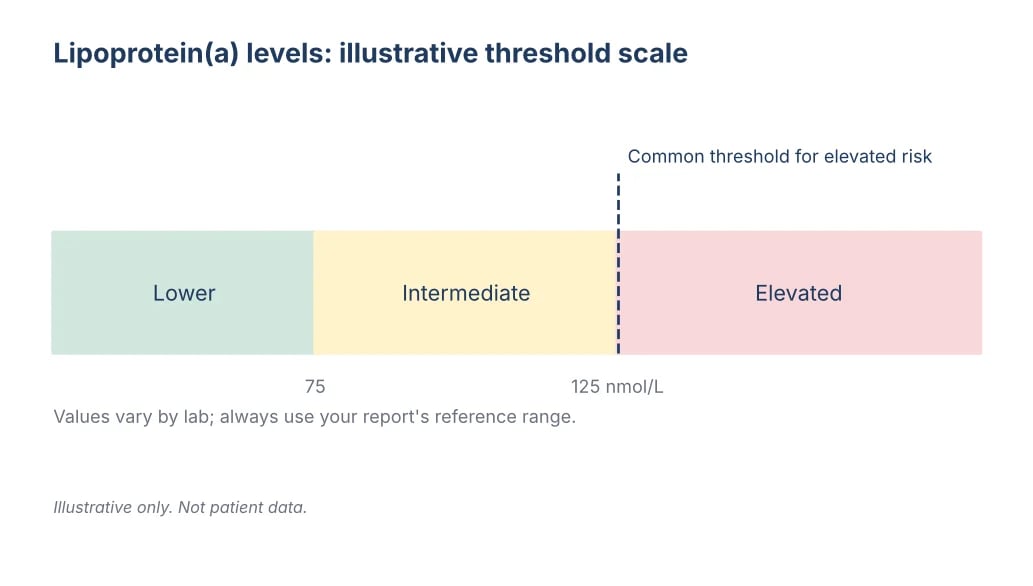
Readers of Liondale's article on lipoprotein(a) will recognize a link. Each lipoprotein(a) particle carries one ApoB, so it contributes to the ApoB count. Lipoprotein(a) is largely genetically determined and does not respond well to diet or most standard lipid therapies, and it carries extra risk because of its other properties.
This means ApoB and lipoprotein(a) are complementary. A high ApoB can reflect LDL, remnants, lipoprotein(a) or a combination. Measuring lipoprotein(a) once in a lifetime helps interpret an ApoB that does not respond as expected, and a high lipoprotein(a) is a reason to be more aggressive about lowering the rest of the particles.
Several factors push ApoB up, and understanding them points to what can be changed.
Genetics play a large role. Variants affecting LDL receptors, ApoB metabolism and lipid handling determine baseline levels, and familial conditions can produce very high values from an early age.
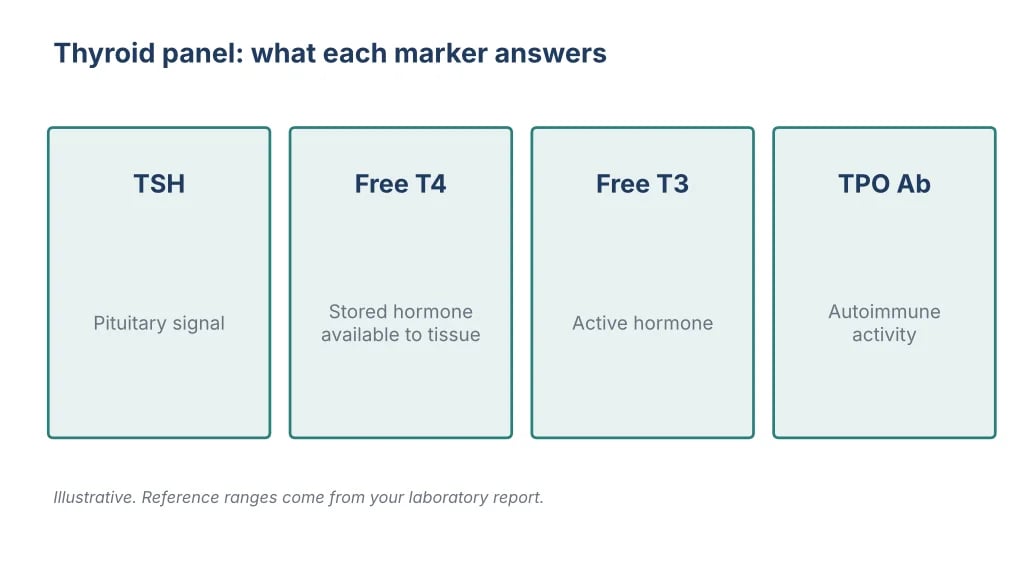
Diet matters, particularly saturated fat and, for some people, refined carbohydrates and excess calories. Weight gain, especially central fat, tends to raise triglyceride-rich particles and ApoB. Insulin resistance pushes the liver to produce more VLDL particles. Hypothyroidism raises LDL, which is one reason the practice emphasizes thyroid labs beyond TSH in a thorough workup.
Medications and conditions can contribute: certain steroids, some antipsychotics, kidney disease, nephrotic syndrome, cholestatic liver disease and poorly controlled diabetes all can raise atherogenic particles. A good evaluation looks for secondary causes before attributing the number to diet and genes alone.
The approach depends on the cause and the risk level.
Lifestyle comes first. Reducing saturated fat, increasing soluble fiber, favoring unsaturated fats, losing excess weight and being physically active all tend to lower atherogenic particles, with the size of the effect varying from person to person. Improving insulin sensitivity reduces VLDL production and can lower ApoB in people whose elevation is metabolic. The practice's discussion of sarcopenic obesity and muscle loss shows why preserving muscle matters for metabolic health during weight loss.
Medication is often needed when lifestyle is not enough or risk is high. Statins are the most widely studied class and lower ApoB by reducing LDL particles. Ezetimibe reduces cholesterol absorption and adds to the effect. Newer agents, including PCSK9 inhibitors and other drugs, lower ApoB substantially and are used in selected patients. Bempedoic acid is another option for some. The choice is individualized and made with a physician, based on risk, side effects, preferences and coverage.
Weight loss medications may also change lipids. The practice has written on GLP-1 drugs and longevity, and one consequence of weight loss and improved insulin sensitivity can be a better particle profile. Lipids should be rechecked after major changes in weight.
Few medications generate as much emotion as statins. Many patients have heard stories of muscle aches, memory worries or diabetes risk, and some have family members who refused them. A balanced discussion acknowledges both sides.
Statins reduce cardiovascular events in people at elevated risk, and the evidence for this is among the strongest in medicine. Side effects exist. Muscle symptoms are the most common complaint, and while large blinded trials suggest that many reported symptoms are not caused by the drug, real intolerance occurs and can often be managed with a different statin, a different dose or an alternative drug. A small increase in blood sugar can occur, and its significance is usually small compared with the cardiovascular benefit in people who need treatment.
The most useful question is not whether statins are good or bad but whether this patient, with this risk, benefits enough to justify treatment. ApoB is one input to that question, alongside age, blood pressure, diabetes, smoking, family history and imaging. A patient who declines a statin should be offered alternatives and a plan, not a closed door.
Hormone status can influence lipids. Estrogen has effects on LDL and HDL, and lipid patterns often worsen after menopause. Thyroid hormone status affects cholesterol clearance. Testosterone therapy can affect HDL and other markers, and patients on it should have lipids monitored as part of routine follow-up.
For this reason, a comprehensive evaluation at a practice that treats hormones and tracks cardiovascular markers in the same visit can be useful. The goal is not to attribute every number to hormones but to avoid ignoring the connection.
If ApoB is normal and risk is low, retesting every year or two is typically sufficient. If it is elevated, a physician will usually recheck after a defined period of lifestyle change or medication, often within a few months, to see if the intervention is working.
It is wise to test under similar conditions each time, with consistent fasting status and without recent illness, major weight change or unusual diet, because these can shift results. If you start a medication, the first follow-up test confirms that the dose is effective, and subsequent tests monitor stability.
Keeping a record of results over time is more informative than any single number. Trends show whether lifestyle changes are working, and they reveal drift that a single test could miss.
A few misreadings come up repeatedly. The first is celebrating a low LDL-C without checking ApoB, particularly in people with metabolic risk. The second is panicking over a single high value without repeating it under consistent conditions. The third is assuming that a very healthy diet guarantees a low ApoB, when genetics can keep it high despite excellent habits. The fourth is treating a number in isolation without considering age, blood pressure, glucose, family history and other risk markers. The fifth is stopping a medication because the number looks good, when the number looks good because of the medication.
The way around these errors is to view a lipid result as one piece of a larger picture and to review it with someone who can place it in context.
Lipid results land in many offices: primary care, cardiology, endocrinology, preventive medicine and longevity clinics. Each brings a different emphasis. A cardiologist may focus on events and imaging, an endocrinologist on metabolic drivers and a longevity physician on long-horizon exposure. None is automatically right for every patient.
The practice's piece on which specialist answers which question is a useful guide to matching a concern with the right clinician. For ApoB specifically, what matters most is that the person interpreting the result is comfortable with particle-based thinking, knows the guidelines, is willing to look for secondary causes and will coordinate with a cardiologist when imaging or advanced therapy is needed.
If the response to an elevated ApoB is a shrug, it is reasonable to seek a second opinion. Equally, if the response is an immediate prescription without a discussion of risk, causes and alternatives, that is also worth questioning. A good answer includes both a number and a plan.
It is also worth bringing the numbers to every provider you see, since ApoB results from one office often do not travel to another. A short personal summary of dates, values and treatments, kept on your phone, saves repetition and prevents decisions based on partial information.
A high ApoB that does not respond well to lifestyle changes can point to an inherited pattern, and inherited patterns affect relatives. If a parent had a heart attack or stent at a young age, or if several family members have high cholesterol, a high ApoB in you is a reason to suggest that siblings and grown children be tested too.
Children of parents with very high cholesterol or early cardiovascular events can be screened in childhood, and pediatric guidelines recommend lipid screening at certain ages. Identifying familial hypercholesterolemia early allows treatment before decades of exposure accumulate. For many families, the discovery that a pattern runs through several generations explains years of unexplained events and gives everyone a chance to act.
It helps to write down the family history in detail before an appointment: which relative, which condition, at what age and what treatment. Vague answers like heart problems on my father's side are less useful than a specific list.
ApoB is a strong marker, but it is not the only one. Coronary artery calcium scoring directly visualizes calcified plaque and can help decide how aggressively to treat. Blood pressure, glucose control, inflammation markers such as high-sensitivity C-reactive protein, kidney function and family history all contribute.
The practice's article on personalized longevity planning with precision diagnostics describes how these tools are combined. The principle is that no single number defines risk, and the best decisions come from integrating several.
Dr. Lionel Bissoon, DO, practices a concierge model, which the practice explains in its piece on concierge medicine. In a standard primary care visit, a lipid result may get a minute of attention. In a model built around longer visits and ongoing contact, a physician can compare serial results, adjust a plan between appointments and answer questions as they arise.
That matters for a marker like ApoB, which is most useful as a trend. Seeing how a number responds to a dietary change, a new medication, weight loss or a hormone adjustment, and acting on it, is where the value lies. The test is simple. The skill is in interpreting it over time and in the context of the whole person.
If your physician has not offered ApoB, you can ask for it. A simple request is enough: please add apolipoprotein B to my next blood draw. In most places it is a routine test and is available through major laboratories. Coverage varies, and some insurers cover it when there is a clinical indication such as elevated triglycerides, diabetes or family history.
Bring your previous lipid panels to the conversation so that trends can be seen. Mention your family history in detail, including who, what and at what age, because that history changes how aggressively a physician approaches the numbers.
At Liondale, Dr. Lionel Bissoon, DO, works within a concierge model that allows time for these conversations, and the practice's overview of anti-aging medicine describes the broader approach to prevention. Appointments can be arranged through the practice's scheduling page.
It is easy to become fixated on a biomarker. ApoB is useful because it is a good proxy for a causal exposure, and it is imperfect like any measurement. A single value does not predict an individual's future, and many people with high ApoB never have an event, just as some with low ApoB do.
The point is to shift the odds. Knowing the number lets you and your physician decide whether to act, how hard and with what. For many people, the answer is simple lifestyle changes and periodic rechecks. For some, it is medication. For a few, it is a discovery that explains a family pattern.
What no one should settle for is a reassuring LDL-C when a more informative number is available and nobody has looked.
Apolipoprotein B is a protein found on every particle that can cause atherosclerosis, including LDL, VLDL, remnants and lipoprotein(a). Measuring it counts the number of those particles.
LDL-C measures the amount of cholesterol carried in LDL particles, while ApoB counts all atherogenic particles. The two usually move together but can disagree.
Yes. This is called discordance. It is more common in people with insulin resistance, high triglycerides, metabolic syndrome or diabetes, who may have many small cholesterol-poor particles.
When LDL-C and ApoB disagree, studies suggest risk tends to follow ApoB more closely, though both are useful and neither replaces a full risk assessment.
Many specialists consider below about 90 mg/dL reasonable for average risk, with lower targets for higher risk. Your physician will individualize the goal.
ApoB can be measured reliably fasting or non-fasting, though your practice may ask for fasting if other tests are included in the same draw.
Genetics, diet, excess weight, insulin resistance, thyroid problems, certain medications and some medical conditions can raise it. A good evaluation looks for secondary causes.
Diet, weight loss, activity and improved insulin sensitivity help many people. Medications such as statins, ezetimibe and others are used when risk is higher or lifestyle is not enough.
Each lipoprotein(a) particle carries an ApoB, so it adds to the count. It is mostly genetic and worth measuring once in a lifetime.
Every year or two if normal, and after a few months of treatment or lifestyle change if elevated, always under similar conditions.
It varies. Coverage is more likely when there is a clinical reason, such as high triglycerides, diabetes or a family history of early heart disease.
No. It raises risk over time but does not predict an individual outcome. It is a reason to review overall risk and decide on action with your physician.
This page was written and medically reviewed by Lionel Bissoon, D.O., founder of Liondale Medical. Dr. Bissoon is a board-certified osteopathic physician specializing in anti-aging and concierge medicine on the Upper West Side of Manhattan.
This content is for educational purposes only and does not constitute medical advice. Individual results may vary. Consult a qualified physician before beginning any new treatment.
Published