Men's Health Specialist in NYC: What a Full Workup Actually Covers
A men's health specialist looks beyond testosterone. See what a thorough workup covers after 40, from heart risk and sleep to labs, and how to choose a doctor.

A man in his early forties tells his doctor that he has lost interest in sex. He is tired, he has put on weight around his middle, and his work has been relentless since the spring. His first question is the one nearly every man asks: is it my testosterone? He has read that it might be, and a clinic advertisement on his phone promised a fix.
Sometimes it is his testosterone. More often it is something else, or several things at once, and testosterone is the thing that gets blamed because it is the most visible hormone in popular health talk. Sex drive in men is a layered system. It depends on hormones, but also on sleep, mood, blood flow, medicines, relationship conditions, body weight, thyroid function and stress. A fault in any layer can lower desire, and testosterone therapy given for the wrong layer will not help and may add risks.
This guide is for men in New York and elsewhere who are trying to work out where their own problem sits. It explains what libido is, how it differs from erectile function and orgasm, what the evidence says about testosterone's role, the long list of conditions that mimic a hormone problem, how a careful workup proceeds, and what treatment looks like when testosterone really is the answer.
Patients use the phrase low sex drive for several experiences that have different causes. Libido is desire: the spontaneous interest in sex, the thoughts and the wish to initiate. Erectile function is mechanical, the ability to achieve and keep an erection firm enough for intercourse. Orgasm and ejaculation are a third component, involving nerves and muscle coordination. A man can have strong desire and failing erections, or good erections and no desire, or both problems together.
The distinction matters because the causes diverge. Erectile difficulty is most often a blood vessel and nerve problem, so it shows up with diabetes, high blood pressure, smoking, high cholesterol and some medicines, and it can be an early sign of cardiovascular disease. Loss of desire is more tightly linked to hormones, mood and brain chemistry. When both are present, the usual explanation is two overlapping causes instead of one. It is common for a man with an erectile problem to lose desire as a reaction, because repeated failure makes the whole subject feel threatening. That pattern is psychological in origin even though it began with a physical difficulty.
A useful question to ask yourself is what changed first. If desire faded and erections stayed reliable when you were aroused, the problem leans toward hormones, mood or medicine. If erections became unreliable first and desire declined afterwards, look to circulation and nerves first. The answer helps a physician choose the tests.
Healthy men have several erections during sleep each night, and many wake with one. These are driven by the brain and the nervous system and depend on adequate testosterone and good blood flow. A man who has lost desire but still wakes regularly with firm erections usually has intact hardware and an intact hormone signal, which points toward psychological or situational causes. A man who has lost morning erections along with desire has a higher chance of a hormonal or vascular cause.
This is not a diagnostic test, and the absence of a morning erection can also reflect poor sleep, alcohol the night before or sleep apnea. Still, it is a simple observation that takes no equipment. Patients who track it for two weeks often arrive with information that shortens the evaluation.
Testosterone acts on the brain, and its effect on libido is real. Men whose testosterone is very low, below roughly 200 nanograms per deciliter, commonly report reduced desire, fewer spontaneous thoughts about sex and fewer morning erections. When testosterone is raised in men who truly lack it, desire usually improves.
The relationship has a threshold quality. Below a certain point, desire declines in proportion. Above it, adding more testosterone does little. A man with a level of 450 does not become more interested by moving to 800. This explains why the largest randomized trial in older men with low testosterone, the Testosterone Trials, found that treatment modestly improved sexual desire, activity and erectile function compared with placebo in men whose levels were clearly low, but that the effects were moderate and not universal. Some men improved a great deal. Others barely noticed a change.
The takeaway is that testosterone is a necessary condition for normal desire, not a sufficient one. Take it away and desire fails. Restore it in a man who lacked it and desire often returns. Add it to a man who already has enough and nothing much happens, which is the situation for a large share of men who ask for treatment on the basis of fatigue and low drive alone.
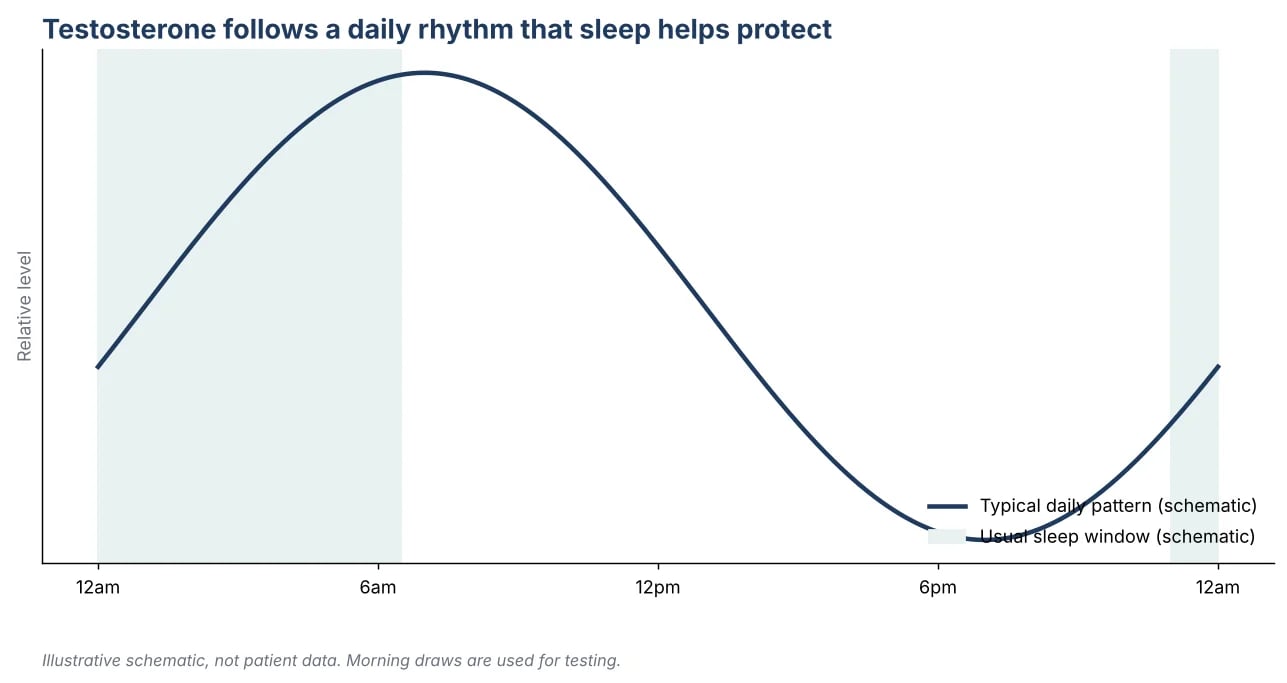
Medical societies define low testosterone as a combination of symptoms and consistently low blood levels. The Endocrine Society uses a total testosterone below about 264 nanograms per deciliter on repeated morning measurements as the lower limit of normal for healthy young men, and the American Urological Association uses 300. The diagnosis requires two separate fasting morning samples, because testosterone varies by hour, day and illness. A single low value after a bad night's sleep, a stressful week or an infection can fall into the low range and then recover.
Total testosterone is not the whole picture either. Most testosterone in blood is bound to proteins, particularly sex hormone-binding globulin, and only the free and loosely bound fractions are available to tissues. Obesity lowers binding protein and therefore lowers total testosterone while free levels may be fine. Aging, liver disease and an overactive thyroid raise binding protein, so total testosterone may look normal while free testosterone is low.
Men who use testosterone, steroids or unmonitored supplements sometimes find their drive falling instead of rising. The explanation lies in the downstream effects. When testosterone is supplied from outside, the brain stops sending the signal that tells the testes to produce their own. That reduces the intratesticular hormone supply and, in some men, shifts the balance of testosterone to estradiol. Very high estradiol is associated with reduced libido, erectile difficulties and mood changes in men. At the other extreme, estradiol driven too low by an aromatase inhibitor also lowers desire.
Supraphysiologic levels can also cause anxiety, irritability, sleep disruption and a feeling of being wired, none of which helps desire. And men who stop high-dose steroids often experience a prolonged slump in drive while their own production recovers, a period that can last months. If you are taking anything that raises testosterone and your desire has fallen instead of improving, check estradiol, hematocrit and the dosing schedule with a physician before changing anything.
Prolactin is a hormone from the pituitary gland that stimulates milk production in women and suppresses the reproductive axis in both sexes when it is too high. In men, elevated prolactin lowers testosterone, reduces libido, can cause erectile dysfunction and, in more advanced cases, produces breast tenderness or visual field changes if a pituitary tumor is pressing on nearby structures. Most prolactin-secreting tumors are benign and respond well to medicine.
Prolactin can also rise from medications, notably certain antipsychotics and some anti-nausea drugs, from kidney disease, from an underactive thyroid and from stress or recent exercise. A level that is mildly elevated is often repeated before anything else is done. A markedly elevated level triggers an MRI of the pituitary. Because the finding is treatable and because the symptoms look so much like low testosterone, a prolactin measurement belongs in the workup of any man with unexplained loss of drive.
An underactive thyroid slows everything, including sexual interest. Men with hypothyroidism report fatigue, weight gain, cold intolerance, constipation and depressed mood, and many have reduced libido and delayed ejaculation. An overactive thyroid can do the opposite in the early phase but often leads to erectile difficulties, anxiety and reduced desire as it progresses. The change in binding protein also alters the testosterone numbers.
Mood and desire are tightly linked. Depression is among the most common reasons for loss of interest in sex, and the loss is often part of a broader pattern of anhedonia, where the things that used to bring pleasure no longer do. Anxiety does it differently, by keeping the nervous system in a state that suppresses arousal.
Treatments add another layer. Selective serotonin reuptake inhibitors, the most commonly prescribed class of antidepressants, reduce libido in a substantial share of men who take them, delay orgasm and can cause erectile problems. These effects do not always fade over time. Other drugs have similar effects: some blood pressure medicines, finasteride and dutasteride in a small percentage of users, opioids, anticonvulsants, antihistamines in large doses and chronic cannabis or alcohol use.
If the loss of drive began within weeks of starting a medicine, this is the first possibility to raise with the prescriber. Changing the drug, adjusting the dose or adding a medicine with the opposite effect can resolve the issue. It is never wise to stop an antidepressant abruptly, and a physician should guide any change.
Testosterone is produced largely during sleep, and a week of short nights lowers it measurably in healthy young men. Chronic sleep restriction has the same effect over time. Beyond the hormone, tired men are simply less interested.
Obstructive sleep apnea deserves particular mention. It is common in men over forty, especially those with a thick neck or extra weight, and many have never been tested. Repeated drops in oxygen and surges of stress hormones during the night lower testosterone, reduce morning erections and leave the man exhausted. Treating apnea often restores energy and sometimes sexual function without any hormone therapy. A partner who reports loud snoring or pauses in breathing is a strong signal to pursue a sleep study.
Excess abdominal fat is one of the strongest predictors of low testosterone in middle-aged men. Fat tissue contains aromatase, which converts testosterone to estradiol, and it lowers binding protein, which reduces total testosterone. Insulin resistance and type 2 diabetes reduce testosterone further, and the relationship runs both ways, since low testosterone promotes fat gain and loss of muscle.
In many men with obesity and low testosterone, weight loss alone raises testosterone substantially, sometimes into the normal range. This is one reason that physicians recommend lifestyle changes before or alongside hormone treatment. The article on sarcopenic obesity and muscle loss explains the interplay between fat gain and muscle loss that often accompanies this pattern. Men who use weight loss medicines should also understand how rapid weight loss affects hormones and lean mass - read more here: GLP-1 drugs and longevity.
Erectile difficulty and low desire are sometimes the first sign of vascular disease, because the penile arteries are small and show damage earlier than the heart's larger vessels. Men with new erectile problems, particularly under age fifty, should have a cardiovascular risk assessment. Chronic kidney disease, liver disease, chronic obstructive lung disease, HIV, inflammatory conditions and cancer treatments also lower testosterone and desire. Heavy alcohol use damages the testes and the liver and raises binding protein. Opioids suppress the entire hormone axis.
Chronic stress raises cortisol and competes with sex hormones for the body's resources. Men under heavy stress at work, caring for a sick relative or going through divorce or grief often lose interest in sex without any hormone abnormality.
Relationship factors matter as well. Unresolved conflict, differences in desire between partners, lack of privacy, new parenthood and performance anxiety all depress drive in ways no lab will detect. A doctor who asks about these topics is not prying. These are some of the most common causes, and addressing them with counseling or sex therapy is often more effective than any prescription.
Desire rarely falls alone. Men with low drive usually report a cluster: less energy, flatter mood, poorer concentration, slower recovery from exercise and a general sense that the engine is running at half speed. That cluster fits low testosterone, but it fits an equally long list of other problems, including anemia, depression, sleep apnea, thyroid disease and simple overwork.
The practical lesson is to avoid chasing a single symptom. A man who focuses only on desire may miss the sleep problem driving it. A man who focuses only on energy may miss that his mood has been declining for a year. Describing the whole cluster to a physician, in the order it appeared, gives the best chance of finding the real cause.
Testosterone falls slowly with age, by roughly one percent a year after the thirties in many men, though the pace varies. A level that was 700 at thirty may be 500 at fifty without any disease. That drop on its own seldom causes symptoms, and a number in the low-normal range for a fifty-five-year-old does not prove that testosterone is the reason for reduced interest in sex.
Age brings other changes that matter as much: slower arousal, longer recovery between encounters, more health conditions, more medicines and more life stress. A physician who tells a fifty-eight-year-old that his desire is lower than it was at twenty-eight is stating the obvious. The useful question is whether the change is larger or faster than expected, whether it bothers him, and whether something treatable lies underneath. Men should expect a clear answer on those points, and not a promise that treatment will restore a twenty-five-year-old's drive.
Many men carry this problem silently for a year or more before raising it. Partners, meanwhile, often interpret reduced interest as a sign of lost attraction or an affair. Neither assumption is usually correct, and the silence does harm. Telling a partner that you have noticed a change, that you are getting it checked, and that it is not a verdict on the relationship removes a layer of pressure that is itself suppressing desire.
Some couples benefit from a few sessions with a therapist trained in sexual health. This is especially true when the physical workup finds nothing, when a medicine cannot be changed, or when a long pattern of avoidance has built up. Counseling does not replace a medical evaluation, but it addresses what blood tests cannot.
Alcohol is a sedative that dulls arousal in the short term and damages the testes and liver in the long term. Men who drink heavily often have lower testosterone, higher estradiol and more erectile difficulty, and these improve when intake falls. Daily cannabis use is associated in some studies with lower desire and testosterone, though the evidence is mixed. Opioids, including prescription pain medicines, suppress the hormone axis and are among the most reliable causes of low testosterone in men who take them regularly. Stimulants, nicotine and anabolic steroids add their own effects. Being candid with a physician about all of these is more useful than being tactful, because the plan depends on it.
The market for testosterone boosters is large and weakly regulated. Most products contain herbs, vitamins and minerals with little evidence that they raise testosterone in men whose levels are normal, and some contain undeclared drugs. Zinc or vitamin D corrects a real deficiency but does not push a normal level higher. Bringing the actual bottles to an appointment lets the physician check ingredients and interactions. Any product that promises a dramatic rise in libido within days should be treated with suspicion.
A competent evaluation begins with a conversation that covers when the problem started, whether it is constant or situational, whether desire returns with a new partner or in particular circumstances, what the erections are like, medicines and supplements, alcohol and substance use, sleep, mood, weight change and stress. Situational loss of desire, for example, is rarely hormonal.
A physical examination looks at body composition, blood pressure, testicular size and consistency, breast tissue, body hair, and signs of thyroid or vascular disease. Testicular volume and texture offer clues about whether the testes are working.
The laboratory work typically includes two morning fasting total testosterone measurements on separate days, sex hormone-binding globulin and free testosterone, estradiol by a sensitive method, luteinizing hormone and follicle-stimulating hormone, prolactin, thyroid studies, a metabolic panel, hemoglobin A1c, a lipid panel, a complete blood count and, in many cases, prostate-specific antigen. Whether to fast, and why timing matters, is explained in the practice's note on fasting before blood panels.
If testosterone is low, the luteinizing hormone result sorts the cause. A high value means the testes themselves are not responding, which is called primary hypogonadism. A low or inappropriately normal value means the brain's signal is faulty, which is secondary hypogonadism and prompts a search for pituitary disease, obesity, sleep apnea, medicines or other drivers. The distinction determines the treatment options, including whether fertility can be preserved. The practice's overview of what a full men's health workup covers lays out the sequence in more depth.
If a man has symptoms consistent with low testosterone, two clearly low morning measurements and no reversible cause that explains them, treatment with testosterone is reasonable. The goals are to restore energy, mood, muscle, bone density and sexual function, and the first signs of improvement in desire usually appear within three to six weeks, with fuller effects over several months.
Treatment is not casual. It requires baseline and follow-up monitoring of testosterone, hematocrit, prostate-specific antigen and symptoms. It can reduce sperm production dramatically, which matters for men who want children, and for them there are alternatives that preserve fertility.
Anyone weighing the options can look into testosterone replacement therapy for men, which describes the forms of treatment, what each involves and how monitoring works. The choice between them depends on lifestyle, tolerance for injections, fertility plans and how closely a man wants to adjust his dose over time, and none is universally better.
Men with low testosterone and a clear contributing cause, such as sleep apnea, obesity or a medicine, often do better by treating that cause first and then reassessing. If testosterone rebounds, therapy may not be needed at all.
If levels are normal, adding testosterone is unlikely to help and carries real downsides: suppressed sperm production, increased red blood cell counts, acne, possible worsening of sleep apnea and the need for ongoing monitoring. A man in this position is better served by identifying what is actually driving the symptom. That might mean adjusting a medicine, treating depression or anxiety, evaluating sleep, losing weight, addressing a vascular problem, or pursuing counseling.
It is also worth remembering that desire naturally varies. It changes with age, with the length of a relationship and with the circumstances of life. A lower level than at twenty-five is not a disease. The test of whether it is a problem is whether it troubles the man or his relationship, and whether it represents a change from his own baseline.
Phosphodiesterase inhibitors improve blood flow and are effective for erectile difficulty in most men, but they do not increase desire. A man with low libido and normal erections gains little from them. A man with both problems may benefit from treating the erectile component while the cause of low desire is investigated, since restoring confidence often helps. These medicines require a physician's evaluation because they interact dangerously with nitrates and some other drugs and because erectile difficulty can signal heart disease.
Keep a simple record for two weeks: sleep hours, morning erections, mood, alcohol, exercise and any sexual activity or interest. Gather a list of all medicines and supplements with start dates. Arrange for morning blood draws, ideally fasting, and avoid heavy exercise and alcohol the day before. If you take testosterone or have recently stopped, note the date of the last dose. Bring previous lab reports so trends are visible.
Think also about what you want from treatment. For some men the goal is simply understanding. For others it is restoring the energy and desire they had five years ago. Naming the goal helps the physician choose between observation, lifestyle measures, medicine changes and hormone therapy.
The practice offers consultations with Dr. Lionel Bissoon for men who would like an unhurried look at the full picture, and appointments can be arranged on the scheduling page.
Low sex drive is a symptom with many roots. Testosterone is one of them, and an important one when it is truly low, but in a large share of men the cause lies in sleep, mood, medicines, weight, thyroid or pituitary function, or the circumstances of life. A careful history, the right morning blood tests and a willingness to look past the first explanation lead to the right answer more reliably than a quick prescription.
The reward for doing it properly is that the answer, when found, is usually specific and treatable. A man with sleep apnea gets treated for sleep apnea. A man with a medicine effect adjusts the medicine. A man with truly low testosterone starts a monitored plan. And a man whose levels are fine learns that, which is itself useful and lets him turn attention to what is really going on.
Common causes include low testosterone, depression, anxiety, medicines such as antidepressants, sleep apnea, poor sleep, obesity, thyroid disease, high prolactin, alcohol, chronic illness and relationship or stress factors. Often more than one is involved.
Yes. Very low testosterone, particularly below about 200 ng/dL, commonly reduces desire. It is only one possible cause, so other factors should be checked before treating it.
It can, indirectly. High doses from outside the body can raise estradiol, disrupt sleep and mood, and suppress the body's own production. Estradiol that is too high or too low is linked to reduced desire.
With symptoms plus two separate fasting morning total testosterone measurements below about 264 to 300 ng/dL, usually with free testosterone, SHBG, LH and other hormones to find the cause.
Libido is desire. Erectile dysfunction is difficulty achieving or keeping an erection. They have different causes, can occur separately, and often coexist.
They are a useful clue. Regular firm morning erections suggest the hormone signal and blood flow are intact, which points toward psychological or situational causes. Their loss raises the odds of a hormonal or vascular problem.
Yes. SSRIs reduce libido and delay orgasm in many men. Do not stop on your own. Ask the prescriber about dose changes or alternatives.
Yes. Apnea lowers testosterone, fragments sleep and causes exhaustion. Treating it often improves energy and sexual function.
Yes. Abdominal fat converts testosterone to estradiol and lowers binding protein. Weight loss alone can raise testosterone significantly in many men.
Usually not. Adding testosterone to normal levels rarely improves desire and brings risks such as suppressed sperm production and higher red blood cell counts.
Two fasting morning total testosterone tests, free testosterone and SHBG, estradiol, LH, FSH, prolactin, thyroid studies, a metabolic panel, A1c, a blood count and often PSA.
When low testosterone is the cause, desire often starts improving within three to six weeks, with fuller effects over several months. Results vary between men.
This page was written and medically reviewed by Lionel Bissoon, D.O., founder of Liondale Medical. Dr. Bissoon is a board-certified osteopathic physician specializing in anti-aging and concierge medicine on the Upper West Side of Manhattan.
This content is for educational purposes only and does not constitute medical advice. Individual results may vary. Consult a qualified physician before beginning any new treatment.
Published