NAD+ IV Therapy: How It's Different From a Standard Vitamin Drip
How NAD+ IV therapy differs from a standard vitamin drip: mechanism, infusion time, what it targets, and candidacy. Liondale Medical, NYC.

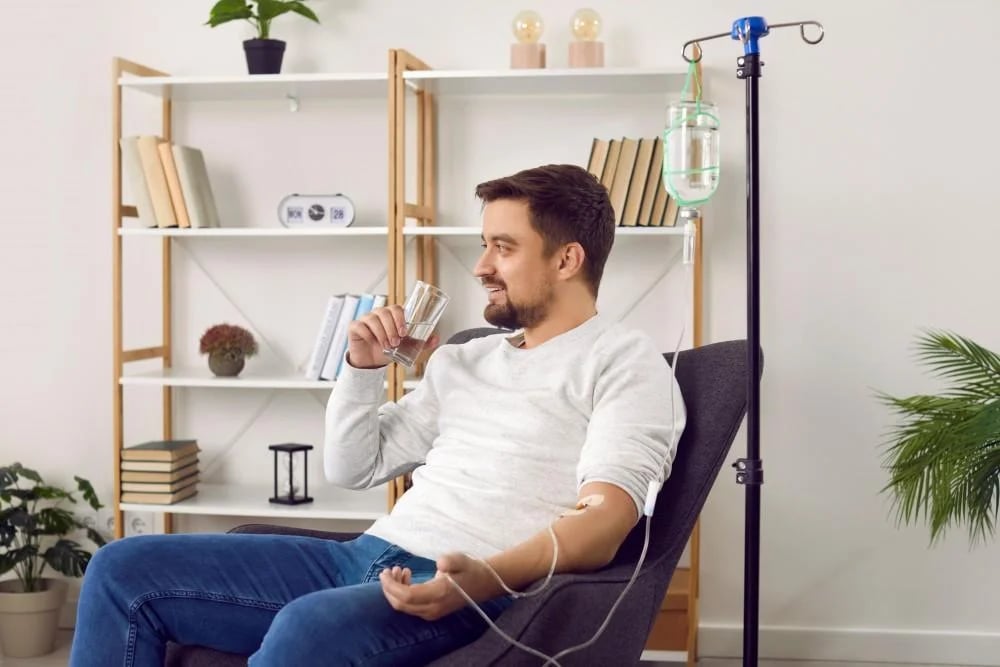
Someone in Manhattan types iv therapy at home into a search bar after a long week. The idea is appealing: a nurse arrives at the apartment, hangs a bag of fluids and vitamins, and the person recovers on the couch. No travel, no waiting room, no hour lost. The companies offering this are numerous, and many are run by careful clinicians.
The question worth asking is not whether home infusion is allowed or whether it is convenient. It is what actually changes between a living room and a physician's office, and whether those changes matter for the particular infusion and the particular person. For a plain bag of saline in a healthy adult with a mild illness, the differences may be small. For high-dose vitamin C, for NAD+, for someone with a heart or kidney condition or for anyone who has never been screened, they can be large.
This guide walks through what an infusion actually does to the body, where the risks sit, what a proper screening covers, how emergency readiness differs by setting, how to judge the quality of what goes into the bag, and when a home visit is reasonable. It is written for New Yorkers comparing options and does not argue that one setting is always right.
Taking a nutrient by mouth sends it through the digestive tract and the liver before it reaches the bloodstream. An intravenous infusion places it directly into circulation, which is the point of the treatment and also the source of its risks. The body's usual filters are bypassed. Dose, speed and purity all matter more because there is no gate between the bag and the heart.
Three physical facts follow. First, the volume infused adds to the fluid already in the body, and some people cannot handle extra fluid. Second, the speed of delivery changes how a substance behaves, so a compound well tolerated over three hours can cause trouble over thirty minutes. Third, the needle and catheter create a pathway through the skin that can carry bacteria into the blood if anything about the technique, the supplies or the preparation is off.
None of these facts is dramatic in a healthy adult receiving a standard hydration bag. They become relevant at the edges, which is where screening and monitoring earn their place.
The most common problems with IV therapy are minor: bruising at the site, a brief sting, a cold sensation as fluid enters the arm, lightheadedness. A few are more serious and are worth knowing.
Infiltration occurs when the catheter slips out of the vein and fluid leaks into the surrounding tissue, causing swelling, pain and, with irritating solutions, tissue injury. Phlebitis is inflammation of the vein itself. Infection at the site or in the bloodstream is uncommon with good technique and can be severe when it happens. Air in the line, though rare with modern equipment, is a hazard that standard practices are designed to prevent.
Fluid overload matters for people with heart failure, kidney disease or certain liver conditions, and it can occur in older adults who seem otherwise well. Electrolyte shifts matter for people on diuretics or with kidney problems. Allergic reactions, including anaphylaxis, can occur with any injected substance and are unpredictable. Some compounds have specific hazards: high-dose vitamin C can trigger hemolysis in people with a certain inherited enzyme deficiency, and rapid infusion of some substances causes chest tightness, nausea or flushing.
The point is not that these risks are likely. For most healthy people, they are not. The point is that they have known answers, and the quality of those answers depends on who is present, what has been checked beforehand and what equipment is within reach.
In New York State, administering intravenous therapy is a medical act. It is performed by a licensed physician, nurse practitioner, physician assistant, registered nurse or other licensed professional acting under appropriate authority, which generally means a physician's orders or a practice agreement, and the specifics depend on the professional's license and scope. A nurse working in a home setting still needs a prescriber who has evaluated the patient, written the order and remains responsible for the care plan.
For that reason, a reasonable question for any provider, home or office, is who the supervising or ordering physician is, whether that person has reviewed the patient's history, and how to reach them if something goes wrong. A company that cannot say is not necessarily unsafe, but the question is fair and the answer is informative.
A responsible infusion begins before the needle. A screening conversation, and in some cases blood work, answers questions that change what should go into the bag or whether an infusion should be given at all.
The history covers heart, kidney and liver disease, diabetes, high blood pressure, thyroid conditions, anemia, bleeding disorders, pregnancy, previous reactions to infusions or medicines, current medicines and supplements, alcohol use and recent illness. Each item can change the plan. A person with heart failure needs a small volume. A person with kidney disease may not tolerate certain minerals. A person on blood thinners needs care with the puncture. A person with an active infection may need treatment, not a wellness drip.
Laboratory screening comes next, and its importance depends on the infusion. Before high-dose vitamin C, testing for glucose-6-phosphate dehydrogenase deficiency is standard practice, because in people who lack the enzyme, large doses of vitamin C can cause red blood cells to break down. The condition is more common in people of African, Mediterranean and Middle Eastern descent but occurs in others, and it is usually undetected until a trigger. A basic metabolic panel confirms that kidney function and electrolytes can handle the planned infusion. A blood count identifies anemia and infection. For some infusions, magnesium, vitamin levels or other markers guide dosing and avoid giving what the body already has in excess.
This is where home services vary most. Some mobile providers do an in-depth intake and require recent labs. Others rely on a questionnaire completed online, and the infusion proceeds the same day. The latter model is faster and not necessarily dangerous for a basic hydration bag, but it is not equivalent to a process that checks a person's specific risks. The practice's discussion of what a blood sample goes through after the draw is useful for understanding how lab results are generated and why timing matters.
People often use the phrase IV therapy as if it were a single treatment. It spans a range, and the range matters for the home-versus-office question.
At one end is plain fluid with electrolytes, which is similar to what is given in an emergency room for dehydration. A modest vitamin and mineral blend is next, often called a Myers-type cocktail. Beyond that are higher-dose single-nutrient infusions such as vitamin C, glutathione and others, and then NAD+ infusions, which have their own behavior. Separate again are medicines such as ketamine, chelating agents or peptides, which carry entirely different risk profiles and legal requirements and which this article does not address.
NAD IV therapy compared with a vitamin drip explains why these are not interchangeable products. For anyone considering a particular infusion, understanding what it is, what it is supposed to do and what evidence exists for it comes before choosing where to receive it.
Search interest in NAD IV in New York is high, and the infusion has a feature that affects setting: its rate. NAD+ delivered quickly commonly causes chest pressure, abdominal cramping, nausea, flushing and a sense of anxiety. These are not signs of an allergy. They reflect how the molecule affects the body when it arrives fast. Slowing the infusion typically relieves them.
A typical session therefore runs for several hours, and a clinician who knows the infusion adjusts the pace in response to what the patient reports. In a clinic, a nurse sits nearby, watches the patient and changes the drip rate. In a home setting, a nurse may be present for the entire time or may start the line, set the rate and leave. A patient who is left alone with a running NAD+ infusion and feels chest tightness has to decide on their own whether it is a nuisance or something else.
For this reason, if a home NAD+ session is under consideration, the key questions are whether a clinician stays for the entire infusion, who adjusts the rate and what the plan is if chest symptoms appear. The comparison between NAD injections and NAD IV therapy addresses the alternatives for people who want NAD+ without a multi-hour infusion.
Much of the demand for home IV therapy comes from a narrow set of situations: a stomach bug, a hangover, jet lag, a hard training block. For those, fluids and electrolytes are the active ingredient, and the extra vitamins are mostly color. A person who is mildly dehydrated can often recover just as well with oral rehydration solution, salt and time. An IV is worth considering when vomiting prevents drinking, when dizziness suggests significant volume loss, or when a person is vulnerable, such as an older adult or someone with diabetes.
It is also worth saying that a hangover is a poor reason to rely on a drip. Repeated use of infusions to recover from heavy drinking treats the symptom and conceals the pattern. A physician is more likely to ask about the pattern than to hang a second bag.
Some wellness programs encourage weekly or monthly infusions indefinitely. The evidence for routine infusions in healthy people is limited. Studies in specific populations, such as people with malabsorption, certain deficiencies or cancer-related conditions, show benefit. Studies in healthy adults taking infusions for general wellness are sparse and mixed.
That does not make an infusion pointless. Some people feel better after one, and a placebo effect from the attention and ritual is genuine and not trivial. But a plan that repeats the same infusion indefinitely without measuring anything is hard to defend. A better pattern defines a goal, tests a baseline, uses the infusion for a set period and checks again.
Infusion safety depends on what a person is already taking. Blood thinners and aspirin increase bruising and bleeding at the puncture site. Diuretics and some blood pressure medicines change how fluid and electrolytes are handled. Certain chemotherapy drugs and antioxidants interact with high-dose vitamin C. Supplements such as high-dose iron, potassium or magnesium can compound what is given in the bag. Kidney disease changes how every infusion is cleared.
This is the practical reason a medication list matters more than it seems. A provider who asks for the list and uses it is applying the same logic a pharmacist does. One who does not ask has no way of knowing whether the standard formula fits the patient in front of them.
An infusion that happens in a living room often leaves no trace in the rest of the patient's medical record. The primary care physician does not know it happened, a cardiologist does not know about the fluid load, and a later reaction cannot be linked to the product that caused it. In a physician practice, the infusion is documented with the product, lot, dose, vital signs and any reaction. If something unusual happens, the record exists.
This sounds administrative, and it is, but it is also the thing that lets care connect across time. Patients with chronic conditions or those who see several specialists benefit most from keeping infusions inside a documented system. Asking a mobile provider for a copy of the infusion record, and sharing it with your own doctor, closes much of the gap.
Reactions to infusions are rare, but a rare event is the one that tests readiness. Anaphylaxis, a sharp fall in blood pressure, a seizure, an abnormal heart rhythm or a severe vasovagal faint are the scenarios a clinic prepares for.
A physician's office typically has epinephrine, antihistamines, steroids, oxygen, suction, a blood pressure cuff and a pulse oximeter within arm's reach, staff trained to use them and, in some cases, a defibrillator. A physician is on site or immediately reachable. The room is arranged so a patient can be laid flat quickly and attended from several sides.
A home visit relies on what the visiting clinician carries and on the emergency services of the city. A well-equipped mobile nurse brings epinephrine and basic supplies. Beyond that, the plan is to call 911. In an apartment building in Manhattan, response times are often quick, but stairs, elevators and doormen all add minutes that a clinic does not have. This difference is small in probability and large in consequence, and each person weighs it according to how comfortable they are with it.
Where and how an infusion is prepared determines how clean it is. In a clinic, medications are stored under controlled conditions, mixed in a designated area using aseptic technique and drawn from sealed, labeled sources. Supplies are checked and logged.
Mobile services transport their supplies, often in coolers or bags, and mix at the point of care. Good ones follow the same standards. Poor ones may carry compounded products of uncertain origin, store them improperly or prepare them on a kitchen counter. Compounded sterile products in the United States are governed by quality standards and inspected by state and federal authorities, and a legitimate provider will say where its products come from and be able to show the pharmacy's credentials.
Questions worth asking include where the bags and vials are prepared, whether products come from a licensed pharmacy, how they are stored and transported, whether single-use items are used consistently and what happens to sharps and waste. A provider who answers confidently and specifically is giving a useful signal.
If a provider asks for blood work first, the timing is worth getting right. Electrolytes, kidney function and glucose are sensitive to hydration and meals, so a draw taken after a night of heavy drinking or a day of fasting can look worse than your baseline.
Labs also serve a second purpose. If a deficiency is found, such as low vitamin D, low B12 or low magnesium, the question becomes whether an infusion is the best route or whether oral or injected replacement does the job more simply. That conversation rarely happens when the only intake is an online form.
Some of the appeal of home IV is the feeling of being looked after, of someone coming to you. That feeling has a real counterpart in concierge medicine, where a physician knows your history and is reachable between visits. The difference is accountability. In a concierge relationship, the clinician who recommends an infusion also owns the consequences and sees you afterward.
For many New Yorkers, the practical middle path is a physician-led office close to home with extended hours, which keeps the convenience of short travel and loses nothing in oversight.
Monitoring means watching the person, not just the bag. In a clinic, staff typically check vital signs before starting, watch the site, ask how the patient feels and respond to changes. The patient is in a reclined chair with a call button. In many cases, a second clinician is nearby.
At home, monitoring depends on the visiting nurse. Some stay for the whole session and check in often. Others place the catheter, start the drip and leave, returning at the end. The second pattern is more convenient for the provider and less protective for the patient, because infiltration, pain at the site, a reaction or a change in how the patient feels may go unnoticed. A patient who dozes off on the couch with an IV running is in a different position from one in an infusion room with a nurse nearby.
Neither pattern is inherently wrong, and some infusions, such as a short hydration bag, are low-risk enough that unattended time is acceptable. It is the match between the infusion and the monitoring that counts.
Most healthy adults who receive a routine hydration or vitamin bag at home from a competent provider will be fine. That is worth saying plainly. The additional risk from the setting alone is small.
The risk rises with the number of things that differ from the ideal: an infusion of higher intensity, a person with more health conditions, a provider who skipped screening, a nurse who leaves, products of uncertain origin and distance from emergency help. Each of these is independent, and each makes the others more significant. A healthy twenty-eight-year-old with a basic bag and a nurse who stays has few of them. A sixty-five-year-old with high blood pressure on a diuretic receiving a rapid high-dose infusion with no recent labs has most of them.
That is why a blanket rule, either that home IV is dangerous or that it is perfectly safe, misleads. The answer depends on the infusion, the person and the process.
Home infusion makes sense when a person is too ill or frail to travel, when the infusion is low-risk and the provider screens properly, when the clinician stays throughout, and when emergency readiness has been discussed. It is also reasonable for people who have had the same infusion repeatedly in a clinic with no reaction and who are following an established plan. Hospital-at-home programs and home infusion for patients with chronic conditions work well because they are built on protocols, supervision and equipment.
It is less appealing for a first-ever infusion of any kind, for NAD+ or high-dose vitamin C, for anyone with a heart, kidney or liver condition, for pregnant women, for those with a history of reactions and for anyone who has not had recent labs. In those situations, the extra layer of readiness in a physician's office is worth the trip.
A short list helps sort careful operations from casual ones. Who is the supervising physician, and how is he or she involved? What screening is required before the first infusion, and are labs part of it? What exactly is in the bag, in what amounts, and where is it prepared? Will a clinician stay for the entire infusion? What happens if I have a reaction, and what equipment is on hand? How are my records kept, and will my primary doctor see them? What is the evidence for what I am being offered, and what are the known side effects?
A provider who welcomes these questions is behaving as a medical practice should. One who treats them as an inconvenience is telling you something.
The advantage of an infusion in a physician-led practice is not the furniture. It is the combination of screening, a clinician who knows your history, supervision, equipment, monitored infusion and records that connect to the rest of your care. When the infusion is part of a broader plan, as with the diagnostic approach described in the practice's article on standard labs versus precision diagnostics, the results can be interpreted and the plan adjusted.
A first visit typically starts with a conversation, not a needle. The physician reviews the history, discusses what the patient hopes to gain, examines vitals and decides whether an infusion is appropriate, what it should contain and whether labs should come first. Patients with certain conditions may be advised to avoid infusions or to choose a different route. Those who proceed receive an infusion in a monitored room, with a nurse checking in and adjusting the rate if needed.
Afterward, the patient is told what to watch for and whom to call. Follow-up looks at how the person felt and whether the infusion served its purpose. In a good practice, the plan is revisited and the infusion is stopped if it does not help, a discipline that is easy to lose when infusions are sold as a product and not delivered as medicine. Preparing is simple: eat a normal meal beforehand unless told otherwise, drink water, bring a list of medicines and wear clothing with sleeves that roll up easily.
Anyone who wants to talk through whether an infusion makes sense can use the scheduling page to arrange a visit at the Upper West Side office with Dr. Lionel Bissoon.
Home IV therapy is a legitimate option when the infusion is simple, the person is well, the screening is real, the clinician stays and the supplies are sound. It becomes a poorer choice as the infusion grows more complex, the person's health grows more complicated and the safeguards shrink. The setting is not the risk by itself. It is the set of things that setting makes easy to skip.
A person who asks the questions above, knows what is going in the bag and chooses a provider who can answer clearly will usually reach the right decision, whether that is a living room, an infusion suite or no infusion at all.
It can be, for a healthy adult receiving a simple hydration or vitamin bag from a licensed clinician who screens properly, stays during the infusion and carries emergency supplies. Safety falls as the infusion becomes more complex or the person has more health conditions.
Licensed professionals such as physicians, nurse practitioners, physician assistants and registered nurses, acting within their scope and under appropriate medical orders. Ask who the ordering physician is.
A health history covering heart, kidney and liver disease, medicines, allergies and pregnancy, and labs when the infusion calls for them. High-dose vitamin C requires G6PD testing first.
People who lack the G6PD enzyme can have red blood cells break down when given high-dose vitamin C. A simple blood test identifies the deficiency before the infusion.
It depends on whether a clinician stays and adjusts the rate. NAD+ infused quickly can cause chest pressure, cramping and nausea, so slow, supervised delivery matters.
Bruising, infiltration of fluid into tissue, vein inflammation, infection, fluid overload, electrolyte shifts and allergic reactions. Most are uncommon and manageable with good technique and monitoring.
Usually. An office has medicines, oxygen and monitoring equipment on hand and staff trained to use them. A home visit relies on what the nurse carries and on calling 911.
Ask where the products are prepared, whether they come from a licensed pharmacy and how they are stored and transported. A reputable provider answers specifically.
Only after a physician reviews your condition. Extra fluid or certain minerals can be harmful, so the infusion may need to be changed or avoided.
For a short, simple hydration bag, brief unattended time may be acceptable. For NAD+, high-dose vitamin C or a first-time infusion, a clinician should be present or immediately available.
They deliver nutrients directly into the blood, which helps people who are dehydrated or cannot absorb well. For healthy people with a balanced diet, the added benefit is often modest and depends on the individual.
A list of your medicines and supplements, recent lab reports if you have them, and any history of reactions. Eat and drink normally unless told otherwise.
This page was written and medically reviewed by Lionel Bissoon, D.O., founder of Liondale Medical. Dr. Bissoon is a board-certified osteopathic physician specializing in anti-aging and concierge medicine on the Upper West Side of Manhattan.
This content is for educational purposes only and does not constitute medical advice. Individual results may vary. Consult a qualified physician before beginning any new treatment.
Published